
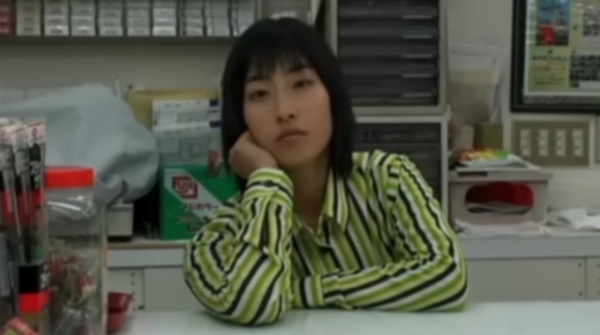
Chô’ kowai hanashi A: yami no karasu, 2004
By the early 2000s, thanks to directors such as Hideo Nakata, Kiyoshi Kurosawa, and Takashi Shimizu, Japanese horror had broken through internationally in a way nobody had expected. What set films such as Ring, Ju-on, and Dark Water apart from what Western audiences were accustomed to, was not extreme violence, but the way in which they built tension through restraint. Rather than relying on what was shown explicitly, they worked through implication, atmosphere, and the slow burn of unease. Much of their power came from what was withheld, creating an unsettling, often quieting effect that lingered long after the film had ended.
By the early 2000s, Japanese filmmaking was also undergoing a quieter technological shift. While the V-Cinema boom of the 1990s had been defined by direct-to-video distribution as a space for genre work that no longer made sense commercially, digital video was now becoming a practical option for feature-length productions. Cheaper cameras and smaller crews changed how films were shot. Yoshihiro Hoshino’s Cursed, released in 2004, sits within this period, arriving just before DV horror would become more widely recognised through later films and TV series.
Screenwriter Yumeaki Hirayama is best known as a novelist, and for his close involvement with the long-running Chô’ kowai hanashi books, a best-selling series of short horror stories. That body of work formed the basis for several low-budget screen adaptations, and Cursed, originally released as Chô’ kowai hanashi A: yami no karasu, emerges directly from Hirayama’s own writing rather than functioning as a detached spin-off. While the original title, translated as Super Scary Story: Crow of Darkness, reflects its place within the wider Chô’ kowai hanashi lineage, the shortened English release title functions as a straightforward alternative for Western audiences and fits the context of the central convenience store’s mysterious presence.
The story centres on Nao Niigaki (Hiroko Sato), who works menial day-to-day shifts as a part-timer at Mitsuya Mart, a seemingly unassuming convenience store that sits on a main road. Few customers pass through, largely due to the strange reputation the store has acquired over the years. Rumours circulate, yet the staff seem unclear about the darker secrets the public appears to know all too well. Once inside, time appears to lose any real sense of meaning, with the store existing as a sealed-off space disconnected from the outside world.
The store’s owners, Mr and Mrs Kitaura (Osamu Takahashi and Etsuyo Hirayama), watch Nao constantly from their broom-cupboard-sized stock room, keeping close tabs on her as though they expect her to steal. During the night shift, Komori (Takaaki Iwao) takes over. He harbours a small crush on Nao, which mostly goes unnoticed, though he is always willing to do her a favour if needed.
Things soon shift when a representative from Cosmos Mart named Ryoko Kagami (Kyoko Akiba) arrives for a meeting with the store owners. Her task is to secure a deal that would see the store renovated and rebranded. While carrying out a stock check, she notices that the Kitauras are keeping out-of-date goods. From there, a series of strange events follows, from odd behaviour to an increasing number of bizarre deaths. All share one thing in common: the store itself and the ground on which it stands.
Shot on digital video, Cursed recalls the work of Kōji Shiraishi, who was emerging around the same period. Shiraishi would later become closely associated with DV horror, particularly through Noroi, which Cursed predates by roughly a year. Like much of Kōji Shiraishi’s work, the film isn’t interested in spectacle. It builds its tension through atmosphere and a steady run of strange, off-kilter incidents. There are long stretches where the emphasis falls on mood and observation rather than explicit violence, even if the final thirty minutes allow for more disturbing material to surface.
It is difficult to watch the opening two or three minutes of Cursed without being reminded of the first Final Destination film, even if that resemblance is never confirmed as a direct influence. Whether intentional or not, the sequence establishes a pattern the film returns to repeatedly, settling into a rhythm shaped by small, self-contained incidents. Each is unsettling in its own way, and as the film progresses they grow more severe, though never reliant on grotesque imagery. The escalation is gradual and controlled, and very much in keeping with the broader language of J-horror.
Structurally, this can leave portions of the brisk 80-minute film feeling uneven. It drifts between incidents, following individual customers as they come and go. Over time, this approach begins to make sense. These figures are not meant to be developed or explained further. They are ordinary, anonymous, and entirely expendable within the film’s own logic.
A brief explanation for the unfolding events is eventually hinted at, tying the deaths to past events connected to the store itself. The film does not dwell on this, and any sense of resolution is deliberately minimal. What remains most effective is how much is left unclear. Cursed is at its strongest when it withholds information, reminding us that there is strength in not having everything spelled out for the viewer.
One of the more refreshing aspects of Cursed is that it doesn’t take itself overly seriously. Director Yoshihiro Hoshino allows moments of unease to sit alongside a dry, sometimes awkward sense of humour. Much of this comes from the eccentric shopkeepers and the uneasy working relationship between Nao and Komori. It’s an unusually strange workplace, quietly hostile rather than openly threatening. That tone is reinforced by the score, which relies on sharp violin strings for much of the film before shifting to a piano arrangement of Bach, carving out a memorable sequence in the final act.
In her feature debut, Hiroko Sato is quietly charming, even though her character has little influence over how events unfold around her. The rest of the supporting cast, particularly Osamu Takahashi and Etsuyo Hirayama, fully embrace the film’s offbeat tone. The way they observe Nao has an overtly voyeuristic quality, with the camera often adopting their point of view. The emphasis is on watching itself, reflecting how paranoid and withdrawn they are rather than any desire to intervene. For fans of Takeshi Miike, Susumu Terajima appears briefly as Tejima, the store owner, bringing a sense of gravitas to the few minutes he is on screen. As a long-established character actor, his presence is immediately felt, and he stands out even in a limited role.
When Cursed was released on DVD in the UK, it was marketed as being ‘in the vein of Ju-on and Ring’. From a sales perspective, the comparison is understandable. This was a cheaply made film, inexpensive to acquire during the J-horror boom, and aligning it with better-known titles was an obvious strategy. In practice, however, Cursed bears little direct relation to those films. While certain familiar hallmarks are present, they are not developed in the same way. Instead, the film plays as a cheaper-looking, more offbeat, and often quirky experiment, one that feels closer to the work of Junji Ito, particularly Uzumaki, with its focus on strange, creeping disturbances overtaking a small town.
Despite its connection to a popular horror brand, Cursed has remained something of an oddity. Its reputation has never extended far beyond its original 2004 DVD release, and it seems unlikely to receive the kind of restoration or reappraisal afforded to more canonical titles. While the Cho Kowai Hanashi books continued to circulate, the film itself led nowhere further.
What remains is a film that’s not exactly a landmark of Japanese horror. It’s strange and tonally offbeat, and largely devoid of clear or satisfying explanations. That ambiguity works in its favour. The result is a curious, self-contained film that’s been largely overlooked, but one that’s well worth your time and never outstays its welcome.
Also available for viewing on Youtube here:
 The Eigakan