
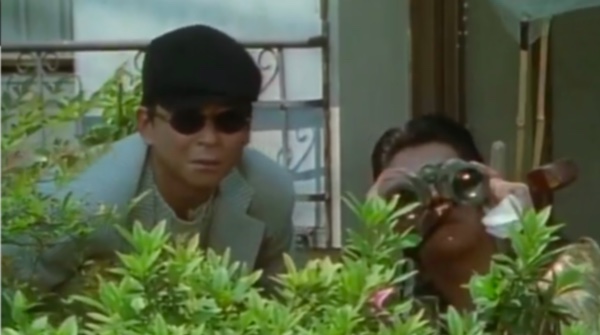
Katte ni shiyagare!!, 1995-1996
Mention Kiyoshi Kurosawa and films like Cure or Pulse tend to spark conversation; they are the works most often cited when his name comes up, and the point at which he became internationally associated with modern Japanese horror. That association, however, arrived relatively late. By the time those films appeared, Kurosawa had already directed more than twenty features, working since the early seventies, across a broad selection of short films, pink cinema and television, in a career that, at that point, hadn’t been defined by any particular genre.
By the mid-1990s, the V-cinema boom prioritised fast production and high output over glossy presentation. Within that system, Kurosawa made his straight-to-video debut with Yakuza Taxi, a light crime comedy in which a struggling taxi firm enlists local yakuza muscle to help pay off a debt to a rival gang. It sits in clear juxtaposition to what yakuza material was expected to deliver at that time, treating the genre in a lighter way rather than taking it too seriously; Kurosawa leans into that freedom, using the project as a chance to work in a way he might not have been able to elsewhere. Still, tensions emerged between him and the original backers during production, but the flexibility of the V-Cinema market allowed those creative differences to exist without collapsing the film.
Yakuza Taxi followed a similarly difficult period after Sweet Home, a visually inventive horror film developed alongside a video game as part of a coordinated media strategy. In later years, that game gained far greater recognition for laying groundwork that would eventually feed into the Resident Evil lineage, while the film itself received a brief LaserDisc and VHS run before disappearing, though not without achieving cult status. In hindsight, it is hard not to see Sweet Home as a pivot point for the director. Whatever its virtues, the experience appears to have prompted Kurosawa to reassess both his creative direction and the conditions under which he was working. Yakuza Taxi drew enough attention to secure a more sustained run in the video market, resulting in a six-part series released between 1995 and 1996. Collectively titled Katte ni shiyagare, the films are better known internationally under the adopted English title Suit Yourself or Shoot Yourself.
At the centre of Suit Yourself or Shoot Yourself are two small-time hoodlums, Yuji and Kosaku, played by Shō Aikawa and Kōyō Maeda. They are not hardened yakuza, but competent criminals working at the margins, taking odd jobs like debt collection, intimidation and, at times, even animal rescue; whenever possible, they prefer to scare rather than resort to violence. For characters operating at this level of the criminal world, they are about as endearing as one could reasonably expect; their hearts, at least, are usually in the right place.
The series title literally translates to ‘Do what you want’, a flippant declaration that hangs over all six films and neatly captures the duo’s bravado. That anti-authoritarian posture runs through the set, even as the later entries begin to question how fully that freedom can actually be sustained.
These features rarely receive much attention in discussions of Kurosawa’s career, in part because of their limited availability and lack of Western distribution. On the surface, they look like disposable V-Cinema crime comedies. Watching them in sequence, however, you start to notice Kurosawa circling the same setup again and again and seeing what sticks.
The films are bookended in near-identical fashion, with Yuji and Kosaku riding into action on their bicycles, bells ringing, and are shot largely in and around Yokohama and the Tokyo Bay area. Locations are reused constantly, from warehouses and docks to marginal streets and industrial zones. Kurosawa would shoot two films back to back, entering production only three times to complete the series; from a financial standpoint, then, this does make a degree of sense. While you could argue that this leaves very little by way of imagination, there’s something about seeing the characters move through the same stretch of the city again and again, without much sense that there’s anywhere else to go.
Visually, Kurosawa avoids flat coverage wherever he can. Even when the camera stays still, characters are carefully blocked within the frame; long, lingering takes and tracking shots let scenes unfold without excessive cutting, giving them room to breathe. Nothing here is showy, but there is a refusal to let the work feel merely functional. Cinematographer Tokushō Kikumura, who would later shoot Cure, Chaos and Ju-on: The Grudge, returns after Yakuza Taxi, and his sensibility fits Kurosawa’s approach cleanly. The director has noted in interviews that he initially leaned towards American-influenced action filmmaking, especially in terms of pacing. Over the course of the series, that intention doesn’t appear to stick to such a model. What emerges instead are films shaped more by characterisation than mood and spectacle, with the action largely reserved for late-stage escalations; comedy dominates throughout, even when violence is present, sometimes abruptly so, it’s frequently trivialised or undercut by humour.
That said, it’s not always rosy and the series takes pains to remind us that not everyone walks away unscathed — that dealing with yakuza carries real risk. While unfortunate bursts of violence do occur, they never tip into extremity. There’s a cavalier attitude towards attempted murder and criminal consequence, and even when the protagonists are directly responsible it tends to be treated lightly, often for laughs. Money is often the catalyst for narrative collapse, through which the stories flirt with danger but rarely with consequence. Serious moments are often scored with light, almost whimsical music, and that approach barely shifts across the first five films, regardless of what’s happening on screen. It’s only in the sixth entry, as the tone hardens, that the score changes, introducing bagpipe themes that play, somewhat bizarrely, alongside the film’s turn towards politics and anti-establishment sentiment.
One way the series sustains interest is though is through casting. Across all six films, Kurosawa draws from a pool of familiar character actors and genre faces, many already associated with crime and action elsewhere. Rather than leaning on established personas, he often casts against type, using actors in ways that run against their usual screen image; the supporting cast rotates from film to film, leaving continuity with the central duo and the framework they carry with them.
Of course, the main stars, Sho Aikawa and Koyo Maeda, are great fun, and they serve as the real anchor of the series. Aikawa, coming from a background in action and genre cinema, tends to play the more serious of the two, often carrying himself with a tougher, more grounded edge, though certainly plays it up a bit. Meanwhile, Maeda, who charted success in the 80s as the leader of the pop band Otokogumi, brings a more youthful spirit to the pairing. Despite that difference, they ultimately feel like two peas in the same pod, young at heart and cut from the same cloth, their shared recklessness and easy rapport holding the films together and the children’s song which plays over each ending credits More no Kuma-san lends a little extra playfulness.
The first film, The Heist, establishes the dynamic cleanly. Yuji and Kosaku operate under a larger figure, here a local bar run by the flamboyant Sensei, played by Ren Ōsugi, alongside the equally authoritative Yumiko, played by Yoriko Dōguchi. While carrying out a job, the pair get into trouble with yakuza and become entangled with a woman whose personal crisis draws them into a scheme beyond their abilities; romance, coincidence, money and crime collide over a brisk eighty minutes. It also features a memorable turn from Shun Sugata, striking given his reputation for fearsome enforcers; here he’s little more than a fumbling loser forced to perform toughness in order to survive.
The second film, The Escape, reshuffles the dynamic slightly, shifting the romantic focus away from Yuji towards a younger couple while keeping the central duo in place; predictably, it’s Kosaku who now becomes involved with someone connected to one of their clients, again letting coincidence do much of the work.
The third film, The Loot, is perhaps the most balanced of the six. It leans closer to a classical adventure structure, with multiple factions circling an illegible treasure map, corrupt authority figures entering the picture, and a brief sense of movement that suggests escape might actually be possible. By the end of the third entry, the pattern is firmly established, and circling back becomes the defining trait. It would be easy to read this as laziness but it comes across as if it’s merely reinforcing mundanity. Yuji and Kosaku are dreamers, and their small excursions offer moments of escape that are only ever temporary. Over time, sadness begins to underpin the films, accumulating gradually until there’s a growing sense that these characters will never catch a meaningful break.
By this point, the available opportunities have all appeared. Women enter as romantic interests, ping-ponging between Yuji and Kosaku. Obscene amounts of cash and drugs exchange hands or go missing. Gangsters intervene. People dream of escaping to another country, whether Australia, Jamaica or Bali, depending on the film. Everything collapses, but it’s treated with flippancy; happiness is framed as one lucky break away, but old habits, bad timing and structural forces pull them back into the same situation.
By the fourth entry, aptly titled The Gamble, the series begins to feel like Kurosawa testing how much mileage the setup can take. Gambling replaces ambition, while the dreams get loftier. There’s no major hook this time, beyond the heroes having free time to do whatever they please, a direct nod to the Japanese title if you will. Of course, money eventually turns up, and so does a young woman for Yuji to fall for, making for few genuine surprises, aside from a fun appearance by Hiroyuki Tanaka, better known as SABU, playing a yakuza in the same year he made his explosive directorial debut with Dangan Runner.
The fifth film, The Nouveau Rich, pushes things into outright absurdity. It opens on a violent shootout but quickly veers into slapstick, to the point where narrative logic starts to dissolve. Characters stumble through scenes like an uninterrupted Three Stooges routine. Even the duo’s work degrades into pointless labour, rescuing runaway animals rendered as stuffed toys for cheap comic effect. The villain this time, Mr Fujita, is after a dozen bags of stolen heroin and interrupts the story at regular intervals, accompanied by a rabid yakuza henchman who literally barks while being held on a leash. Despite it having all the hallmarks of a quirky anime, signs of fatigue arguably show, which becomes more telling once the final instalment comes into view. There are still laughs to be had, and Fujita’s right-hand man Sasaoka, played by Yutaka Funabiki, gets a scene-stealing run. There’s also a line delivered almost casually that comes close to summing up the entire project. Kosaku says, ‘It’s like we’ve got great cards, but we can’t lay any of them down.’ After five films, it’s hard to disagree.
The sixth and final entry, The Hero, breaks the spell however. The familiar formula is turned inside out as Yuji and Kosaku find themselves tangled up in politics. A new figure enters by the name of Aoyagi, played by Susumu Terajima, a man obsessed with justice and intent on targeting even trivial antisocial behaviour. What begins as a crusade against the yakuza shifts towards moral policing and bureaucracy, before edging into something approaching authoritarian control. Homelessness, poverty and social failure move from the background to the centre of the film.
Yuji, who has drifted through the earlier entries largely untouched by consequence, is repositioned here as a symbol. A hero imposed by circumstance, then quietly discarded. The meaning of Katte ni shiyagare is turned inside out, raising questions about what it really means to ‘do what you want’ in a society increasingly preoccupied with order, cleanliness and compliance. The tonal shift here is abrupt. Comedy recedes, and the ending is no longer playful. Time passes as the town is renovated. Residents are expected to fall into line, and the humour steadily drains away. Where the earlier entries often cushioned their seriousness with warmth and jokes, that level of safety is removed. As such, the final film is more concentrated, shedding the warmth of earlier instalments and leaving behind a more direct and unsettling look into the world these characters inhabit.
When the series reaches its conclusion, Yuji and Kosaku move on as they always have, heading into the unknown. The logic of ‘do what you want’ has always shaped how they move through the world, with a careless bravado that borders on recklessness. There’s bitterness to their departure, and an awareness that their freedom has narrowed. Even so, they charge into a hailstorm of gunfire with defiance intact, less in denial of their fate than in acceptance of it.
It’s a sober place to leave characters who once coasted on charm, coincidence and the promise of an easy escape, but the tonal shift does somewhat make sense. Like many comedies, the humour here is rooted in something more bleak, and that comes from the limits of the characters’ lives and the way the same pattern keeps repeating itself. Right from the opening of each film, you see it laid out clearly enough: Yuji and Kosaku wake up in the morning, get on their bikes, head into town, take on a job, talk about getting out of the city and going somewhere else. By the end of the day, things have usually gone wrong; money disappears, trouble follows, and whatever brief sense of escape they’ve allowed themselves collapses, leaving them more or less where they started.
That structure repeats across the series, and at first it’s part of the joke. The familiarity is comforting, even funny, and the rhythm gives the films a loose, easygoing feel. But as the entries stack up, the repetition starts to weigh a little heavier; the situations don’t really change, the outcomes don’t shift, and neither do the characters. What initially plays as comedy slowly takes on a different mood, until by the end it feels less like a running gag than a quiet acceptance that this is simply how their lives are going to keep playing out.
Taken individually, the entries are uneven. Seen together, they capture a period in Kiyoshi Kurosawa’s career where he is experimenting, working fast, and learning what can be done within tight constraints. With V-Cinema still in its infancy, the series becomes a proving ground, made before his major theatrical success, at a point when his approach was still taking shape. Kurosawa has spoken positively about the series in later years, describing it as a complete body of work and expressing some surprise at how little it is discussed. There is a sense that he views these films not as a sideline, but as a meaningful part of his development, one that may yet find a wider audience with time.
Also available for viewing on Youtube here:
 The Eigakan