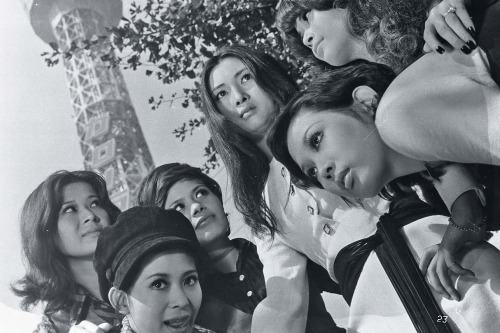
Nora-neko rock, 1970-1971
By 1970, Japan’s major film studios were undergoing a severe crisis as television viewership had begun to far outweigh that of cinema attendances, while films that did perform well theatrically happened to be Hollywood efforts. To combat this unforeseen shift, studios such as Toho, Daiei and Nikkatsu began to rethink the way in which they handled film production; Nikkatsu’s ‘New Action’ films, aimed at the youth market, which had dominated much of the 60s, needed a serious shakeup, which they felt equated to adding more violence and sex in an effort to bring back audiences and speak to a disillusioned generation now caught up in revolutionary idealism.
That shakeup would come in the form of the Stray Cat Rock series, made between 1970-1971, itself inspired by the success of Toei’s Delinquent Girl Boss features, which had themselves taken inspiration from Roger Corman’s The Wild Angels, released in ’66. With Nikkatsu continuing to lose money, they drastically altered their financing, lowering their budgets and allowing for their directors to have complete creative control in exchange for quick turnarounds and meeting specific requirements. The task fell to directors Yasuharu Hasebe and Toshiya Fujita. Between them they made five films: a collection of socio-political tales, which featured disheartened youngsters at their core, with the looming presence of the U.S. military in the backdrop. They were defiant to the last reel, but ultimately they signalled a Death knell for Nikkatsu, who by the end of 1971 ceased production on action films and turned their attention elsewhere.
As part of Nikkatsu’s ‘New Action’ line-up, the Stray Cat Rock series was originally pitched to the studio by talent company Horipro, as a collection of films that were to follow a delinquent biker girl, who travels from town to town helping others like her in need. That role fell to rising Korean-Japanese star Akiko Wada: a former delinquent herself from the streets of Osaka, now under management by Horipro.
In Yasuharu Hasebe’s Delinquent Girl Boss, Wada plays Ako: a no-nonsense gal who soon rushes to the aid of girl gang ’The Stray Cats’, led by Meiko Kaji’s character, Mei, when they’re threatened by local gang ‘The Black Shirts’, under the direction of Katsuya (Tatsuya Fuji). Meanwhile, Mei’s boyfriend, Michio (Koji Wada), has big dreams of joining the fascist Seiyu Group, but in order to do so must convince his best friend – and now pro-boxer – Kelly (Ken Sanders) to throw a boxing match. When it all goes pear-shaped, Michio’s life hangs in the balance, with Kaji and her crew left to race to his aid.
If Delinquent Girl Boss is thin on actual narrative it certainly does well to encapsulate the desperation of its period with a lively swagger. Hasebe’s desire to showcase a feature that comments on a society which infringes upon youthful idealism, affords a great deal of scope in terms of its changing environment. As a city on the cusp of being a world economic powerhouse, the director’s sense of pacing and enthusiasm for directing action from down and dirty viewpoints ends up being both vigilant and immersive. While its social observations come across as being stitched together, with little exploration between, they nonetheless serve as interesting insights into a decade fuelled by protests, ignorance and major social change. And, in a bid to sex things up as per Nikkatsu’s intentions, it also indulges in a little bit of taboo with its homosexual undercurrents; Ako’s overly touchy fondness for female companionship raises questions that it never quite answers – an obtuse quality which only further goes to provide an extra bit of edge to a film which means to end as abruptly as it begins.
It stands to reason, then, that Hasebe would choose to incorporate other voices in the film, designed to appeal to its target audience. With appearances by not only Akiko Wada – who contributes a couple of songs on stage – but also The Mops, Olive, Andre Candre (the stage name of Yosui Inoue) and Ox, Delinquent Girl Boss’s energy is boundless, ensuring a healthy supply of funk and doo-wop beats, which do well to underline its otherwise serious subject matter and carry the message, much like the town’s slogan, that “Everybody can live free”.
By the time Wild Jumbo went into production, however, Akiko Wada had become a pop sensation, scoring multiple hit releases and appearing across national media. With Nikkatsu having considerably cut their budgets and shooting schedules, Wada was ultimately forced to bow out early, and make way for her previous co-star, Meiko Kaji, to take over the reigns.
As such, Wada appears only in re-used footage from Delinquent Girl Boss during its opening set-up, which goes on to tell of a group of young ruffians calling themselves ‘The Pelican Club’ (Kaji, Tatsuya Fuji, Ox vocalist Yusuke Natsu, Takeo Chii and Soichiro Maeno), who cross paths with a beautiful, upper class woman named Asako (Bunjaku Han) and discover that she’s a mistress to the leader of a religious cult known as the Seikyo Society. With the help of Asako, The Pelican gang plan to rob funds from the Seikyo, with their newly acquired arsenal of WWII guns, dug up from a local school ground!
Toshiya Fujita helms Wild Jumbo in a manner that separates it almost abstractly from that of the first feature, harbouring a bevy of subliminal and cartoonish edits and a wildly fluctuating tone that sees it go from bumbling, frat-style comedy to heist thriller. In contrast to Delinquent Girl Boss its look at social standings perhaps resonates on a greater scale with regards to youthful radicalism, particularly as for the majority of its run time we witness the sprightly Pelican Gang run amok throughout various towns, doing little more than upsetting the locals by being a bit noisy and running into rival gang the Seibukai (made up of rich-kid wannabe gangsters), while a ludicrously infectious score by Yoshio Saito plucks away in the background. On opposite sides of the spectrum, the film’s new religious movement backdrop provides a monetary concern. It’s certainly the black sheep of the five films in the series, entirely unhinged and vignette-like in its presentation that you’d be hard pressed to believe that this was anything but outtakes from the previous production; a largely improvised turn of sorts, riffing on Taiyo-zoku and Boso-zoku (youth tribes) culture, masking an otherwise anaemic plot. And just when you think that these kids will happily drive off into the sunset to harass another day, things take a crushing turn as the climax rears its head, basically reminding us that sticking it to the man doesn’t always prove to be fruitful, and reinforcing the idea that our protagonists in this series don’t really deserve the peaceful resolutions that we might otherwise ordinarily seek.
By the time of Wild Jumbo’s release, Meiko Kaji had become a more prominent presence in the series, though still her role was fairly inconsequential to overall plot developments. She’d already proven her acting chops in the likes of Teruo Ishii’s Blind Woman’s Curse in 1970 and in Stray Cat Rock it appeared as if producers were still trying to figure out what to do with her. By the third film, Sex Hunter, Kaji is front and centre as its driving force, donning the famed black, panama-style hat and funky getup that spilled over into the subsequent Female Prisoner Sasori flicks and cemented Kaji as a fashion icon not to be trifled with.
Keeping within its desire to establish common social themes in the series, racial tensions form the backbone of Sex Hunter, as Mako (Meiko Kaji) and her girls come to blows with the male-dominated Eagle gang, led by Baron (Tatsuya Fuji), when Stray Cat member Mari chooses the affection of the half-cast Ichiro, above that of Eagle member Susumu (Jiro Okazaki). This move doesn’t gone down well with Baron, whose distinct memories of his sister being raped by a gang of “Half-breeds”, leads him to go on a vendetta to hunt down every mixed-race member of the town’s population. Soon a stranger by the name of Kazuma (Rikiya Yasuoka) wanders into town, searching for his long-lost sister, whom he believes to be part of Mako’s outfit. When Mako herself falls for Kazuma, Baron is sent into fits upon learning of the man’s mixed-race heritage.
With Yasuharu Hasebe back in the directors seat, Sex Hunter immediately benefits from having not only a tighter narrative and visual elegance, but so too in supplying one of the more serious underlying issues in the series – that of cultural identity, as it brings to the fore Western intrusion and Japanese acclimatisation. Much of this is centred on the plight of Tatsuya Fuji’s Baron, who has an unhealthy obsession with systematically wiping out mixed-raced folk in fear of a seemingly unstoppable Western threat; a long-held resentment spurred on by a terrible memory. Juxtaposing the reality of recently settled Army bases, Baron’s exclamation of being at war himself with the “Half-breeds” creates a manner of implications which are deservedly questioned throughout the feature, creating a paradox worthy of note. It’s no fluke that Sex Hunter sticks to its guns here, and much like the musical accompaniments prior, which complimented themes with like-minded lyricism, the inclusion of female pop group Golden Half – who themselves were comprised of mixed-race members – provides a level of keen observation, with a very clear intent to fashion a more positive reaction; amusingly, the club at which they play states at the door “Japanese people welcome too”, typifying the sense of boiling pressure faced by a young generation still recovering from fierce conflict and uncertain as to where their future lies.
Hasebe directs all of this with the same flair seen in Delinquent Girl Boss, using voyeuristic framing devices, whilst adopting some overseas influence to paint scenes as if a western was playing out before our very eyes, replete with an utterly miserable and futile denouement. Perhaps the most deliberate and assured film of the bunch, however.
By this point, if you’re feeling that everything has become a bit of a blur, with converging plot threads and the same returning cast members, you’d be forgiven for wondering just what the hell is going on. In fact, the fourth feature in the series, Machine Animal, is a quite potent mixture of elements from Delinquent Girl Boss and Sex Hunter, bolstered by a tale which partially examines the volatile relationship between Japan and the U.S. in the midst of the Vietnam conflict.
It tells the struggle of three men: Nobo (Tatsuya Fuji), Sabu (Jiro Okazaki) and Vietnam deserter Charlie (Toshiya Yamano), who are seeking a boat out of Japan to Sweden. They have on hand 500 capsules of LSD, which they try to peddle at a local club, not knowing that it’s already rife with gang activity. When they cross paths with – yet another – Stray Cat girl-gang, led by Maya (Meiko Kaji) they soon find themselves in a hopeless situation when the drugs are stolen. Now they have Maya’s girls to deal with, along with rivals The Dragon Gang, led by Sakura (Eiji Go) and a more villainous Bunjaku Han.
With its elements of racial concerns, Machine Animal is a fairly satisfying extension of Sex Hunter’s themes, pitting its protagonists at the heart of political unrest, with issues of drug abuse and anti-war protesting. With student movements ever present and cultural confusions setting deeper, it’s anarchic tone seems well realised from director Hasebe, who helms his final picture in the series. Here he establishes a desperate tone as our three leads hope to flee a homeland that they feel is now lost to them – a commentary entirely justified given the timing of its release, and one which is fairly delicately handled in its refusal to overly dwell on things and just get downright silly with its back and forth drug and hostage capers and lengthy but fun motorcycle sequences; the latter, which includes Kaji exclaiming the best line of the entire series “Shit! We need Hondas!”, provides perhaps the greatest endorsement for a product ever committed to celluloid. It also has the least amount of on-screen deaths by its conclusion, so that’s something…
What makes Machine Animal rise above some minor failings is that its primary cast members are given an interesting re-shuffle. While Kaji appears in a token role by this point, it’s refreshing to see Tatsuya Fuji taken on a more sympathetic character in Nobo – a self-appointed named derived from “Nobody” – while Bunjaku Han goes against type. Equally Hasebe throws in more experimental camera trickery, sometimes without rhyme or reason, whilst we get plenty more musical interludes to provide momentary relief from several chaotic situations.
With Toshiya Fujita returning to direct the final film in the series, Beat ’71, things take a predominantly reflective turn as a close-knit band of hippies go from aimless wanderers to rescue crew.
The film begins with Furiko (Meiko Kaji) and Ryumei (Takeo Chii) fooling about in the grass, when suddenly they’re interrupted by a biker bang, led by Piranha (Yoshio Harada), who informs them that they’re there to take Ryumei (who has re-named himself from Tadaaki) back to his family. When a fight ensues, Ryumei stabs and kills one of his attackers (Sex Hunter star Rikiya Yasuoka), before he’s knocked out cold, at which point he’s taken away by an elderly gentleman and Piranha – after punching out Furiko – places the murder weapon in her hands, thus framing her and having her sent to prison. Two months later, she makes her escape with her sister Aya (Yuka Kumari); Furiko goes after Ryumei, while Aya heads back to the hippie commune. However, Furiko is soon kidnapped by her boyfriend’s Father, Mayor Araki (Yoshio Inaba), who is up for re-election and can’t afford to have Furiko spread vile accusations. Upon learning of this, Furiko’s band of friends elect to ride into the countryside town of Kurumi, with a newly adopted child in tow, in a bid to save her and restore order to their idyllic kingdom.
Unsurprisingly, Fujita’s Beat ’71 follows a similar pattern to that of Wild Jumbo, with its tale of serious implications: fuelled by Japanese political events but largely sidelined with frivolous vignettes of hippies riding on a five-seater tandem, enjoying the highs and entertaining lifestyle reporters for quick cash. Once again, Fujita uses humour as much as possible, be it through topics of conversation, musical accompaniments (look out for Monkey! star Masaaki Sakai, then at the height of his Spiders fame, spontaneously appear) our gang of misfits entering the town of Kurumi and providing a huge culture shock to its elderly residents. There’s even an impromptu moment involving the appearance of The Mops once again, who proceed to sing their song “Iijanaika”, the title itself roughly translating under context to “Let it be”/“Who cares?” (and a term often used in political protest) suggesting either passiveness or defiance to an inevitable change. This notion, coupled with the gang’s sense of idealism, leads toward a darker turn of events involving patriarchal jabs; Araki and his son’s volatile relationship ultimately plays out well against the adopted family aspect of the former, which does a fine job in delivering its message of what true family means. As the scene inevitably shifts to an abandoned Taijin mine, located beside an old Wild West theme attraction, the destruction invariably ramps up as our hippies face off against corrupt police officers and yakuza, culminating in them saving the day and riding off into that old sunset…
…Of course they don’t, let’s not get carried away here.
Amidst all of this, Meiko Kaji is notably absent, though not entirely missed. Much of this is down to the pleasant performances of the central group and plenty of diverting scenery to help ease the amount of cynicism coursing throughout.
Marking the end of the series, Beat ’71 is by no means perfect, but it does signal a major shift from Nikkatsu, who having found difficulty in restructuring their company, coupled with the box office failure of Sex Hunter, Machine Animal and Beat ’71, turned to new enterprises with the focus on financing Roman Porno productions. Nevertheless, the Stray Cat Rock collection proves to be an important and invaluable part of cinema history, documenting an increasingly turbulent period in post-war Japan. It attempted to speak to a young audience, on their terms, but seemingly failed to provide any worthwhile answers. The end of an era for sure, but a precursor to another decade of historical significance.


 The Eigakan