Blind Woman’s Curse/怪談昇り竜

blindwomanscurse

Kaidan nobori ryû, 1970

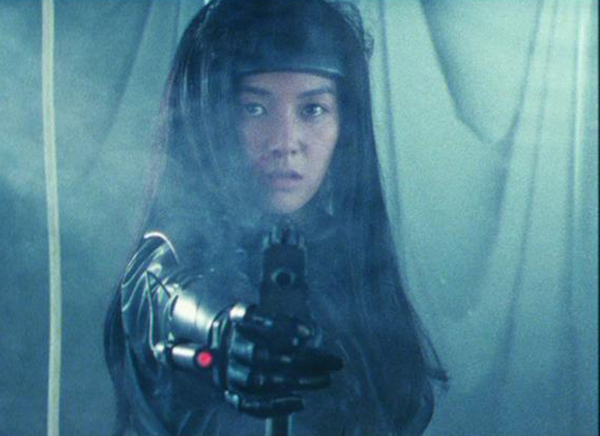
At the end of the sixties, during which time Daiei and Nikkatsu studios were facing somewhat financial difficulties, thanks to poor box office attendance, Teruo Ishii was enjoying freelance reign after a string of hits with Toei. As Nikkatsu moved ever-closer to focusing primarily on Roman Porno flicks, they sought Ishii’s services in the hopes that he’d direct their ‘Rising Dragon’ series, which belonged to the female yakuza sub-genre. Unpreventable commitments elsewhere meant that Ishii could only devote time to two of the three features, the first two of which starred Hiroko Ogi: he would direct The Rising Dragon’s Iron Flesh (Nobori ryu Tekkahada, 1969), while assistant director to Seijun Suzuki, Masami Kuzuo, helmed its follow-up The Rising Dragon’s Skin Exposed (Nobori ryu yawa hada Kaicho). By the time that Rising Dragon Ghost Story (or Blind Woman’s Curse as its become synonymously known in the west) came around, Ogi had moved on to another venture. Nikkatsu and Daiei were beginning to form new strategies, in a bid to secure the box office once again, which happened to involve pooling their resources in looking for promising new acting talent. Enter Meiko Kaji, whose distinctive looks and physicality earned her her first major film role. Teruo Ishii, armed with Miss Kaji, a script co-written by soon-to-be Roman Porno extraordinaire Chusei Sone and the eager blessing of their studio, thus developed what was to be one of the most unusual melding of genres ever seen: a ghostly macabre yakuza tale, which has since gone on to become a cult classic.

The film follows Akemi Tachibana (Meiko Kaji), who is second in line to take over the Tachibana clan. One rainy night, Akemi and her men are involved in a fierce battle with a rival gang, during which time a young woman intervenes, but whose face meets the tip of Akemi’s blade. As the woman lies on the ground in agony a black cat proceeds to lick her wounded eyes, signifying the beginning of a karmic haunting for young Akemi. Soon after the street brawl Akemi is sentenced to three years in prison and upon finishing her term she re-enters the world with a new philosophy on life. Joining up with her clan she learns that it too has re-evaluated its standing, with its elder Ojiki even wanted to disband it and live out the rest of his years running a small restaurant.

With the Tachibana clan now in a much humbled state a gang boss by the name of Dobashi (Toru Abe) seeks to exploit their weaknesses. It turns out that he has a mole placed in the Tachibana clan, whose job it is to make sure that the Tachibana’s go to war with another rival gang, led by Aozora (Ryuhei Uchida). Once these two go head to head Dobashi can clean up the pieces and rule the town for himself. But Akemi no longer wishes to fight, and hopes that she can mediate in a more effective manner, making Dobashi’s plan all the more desperate. When a travelling circus comes into town things soon turn upside down with the arrival of a mysterious blind woman and the deaths of Akemi’s loyal friends. A series of spooky encounters draws Akemi ever closer to facing her fears and dealing with past sins in Teruo Ishii’s bizarre tale of revenge and redemption.

Blind Woman’s Curse initially bares all the hallmarks of a fairly formulaic ninkyo yakuza tale, with director Ishii moving as usual at a quick pace, establishing our characters swiftly and then formulating a plot filled with false loyalties and seedy orchestrators. Indeed, most of the first half of the film is an assured splicing of quirky humour and melodrama, with glorified battles of honour, as well as exchanges of disparaging dialogue between rival clans, who seek to usurp one another. As the film passes the thirty minute mark, however, it becomes something else entirely; quite literally Teruo Ishii turns it into a freakish house of horrors, whereby a crazy athletic hunchback (played by Tatsumi Hijikata, who one year prior starred in Ishii’s Horror of the Malformed Men) leads the film into a far more decadent territory of sex and murderous intrigue. Ishii ushers in a series of incredibly cheesy, though fun special effects, which, along with his stylised compositions, allows proceedings to take on the surreal form that he was always so fondly remembered for. Seeking to weave a thread of uncertain horror, peppered with light scares, the film’s symbolic notion of inevitable retribution wrapped in a little Bakeneko superstition carries it through a deliberately paced and foreboding middle act, as it builds toward its inevitable crescendo: a strikingly staged showdown within a desolate town between Akemi and the eponymous woman of the title.

Despite the sheer predictability of the central storyline, in which the heavily signposted arrival of the title’s mystery blind woman (Hoki Tokuda) signals a strong tie with Akemi – and Ishii’s futile efforts to try and conceal the big twist for as long as possible – Blind Woman’s Curse is elevated further thanks to its commendably strong cast. Kaji, making her debut appearance is quite impressive. Granted she’s no show-stopper, but as a precursor to the kinds of laid back and quieter characters she’d take on at Toei in the early seventies, her presence is a curious one for completeists alone. There are, however, lengthy durations in which Miss Kaji is absent, making way for a host of wonderfully colourful and over-the-top tertiary support, who happily prance around the intimate and surreally-lit environment of quaint houses and opium dens, complete with their obligatory fill of naked ladies and more-than-corrupt gang bosses. When paired with Ishii’s trademark bouts of fitting humour as well, it’s enough to ensure that Blind Woman’s Curse remains as ridiculously fun as it is totally absurd, right through to its very end.

Posted in Uncategorized | Leave a comment

Battle Girl/バトルガール

battlegirl

Batoru Garu, 1991

When a meteor crashes into Japan, creating an unexplainable force field within the heart of Tokyo, the Ground Self-Defence Force, led by Captain Fujioka (Pink Eiga veteran Shiro Shimomoto) places a blockade around the city as they declare martial law. Shrouded in darkness, its citizens have little place to go, nor viable means to survive, with the immediate closure of all services and an escalation in violent crime. Unfortunately the meteor’s landing seems to have brought even bigger issues: a virus capable of raising the dead and turning them into dim-witted cannibals.

Enter K-Ko (Cutie Suzuki): a young woman working for a vague organization, which has asked her to help find survivors and fend off the zombie horde because she’s the best of the best of the best – in whatever it is she does. Armed only with the latest in battle-suit technology, K-Ko must save Tokyo and take down a very bad man with only one goal in mind. I’ll leave you to guess what that is.

Kazuo Komizu began his career at the tail-end of the 1960s as a screenwriter for the rising Pink Cinema scene, making his debut as a co-author on Koji Wakamatsu’s Go Go, Second Time Virgin. It was one of very few films in Komizu’s career which would make it onto DVD in the west in an official capacity over a decade ago: a dark coming-of-age tale of sexual exploration and abuse. Komizu and Wakamatsu would continue working together for a couple more features, allowing Komizu to explore other avenues as an Assistant Director. He would subsequently go on to work with other esteemed directors, such as Pink Cinema greats Masaru Konuma and Mamoru Watanabe; experiences that would prove especially fruitful throughout the eighties with Komizu gaining more immediate recognition thanks to a number of self-penned “erotic” horrors (“erotic” being applied very loosely I might add). Shortly after the notorious Female Market he made his directorial debut with Guts of a Virgin in 1986. Like many others that featured his involvement, it was bootlegged for quite some time, until U.S. label Synapse issued it and one of its two follow-ups several years ago. Continuing to show its appreciation for the director’s work, the company put forth his 1991 V-Cinema outing: Battle Girl.

It’s a slight departure for Kazuo Komizu. Nowhere near as violently graphic, nor sexually depraved as his earlier features, the director takes a different step in his career with a feature that despite its unrated certificate here, is largely an inoffensive and lightweight affair, with not a great deal to even warrant parents shielding it from young prying eyes. It’s the director at his most sedate, helming a science fiction horror with all the enthusiasm of a cat on its way to the vet.

It’s not long before Battle Girl’s influences start to seem apparent, coming across as a bit of a pastiche of U.S. cult action/SF cinema and Japanese comics. From George Romero and John Carpenter to Mamoru Oshii, Komizu’s feature, with its representations of social decay, comfortably nestles itself within the Cyberpunk genre; its dystopian visions and socio-political commentary lending themselves to a rather typical scenario involving national isolation and the fight for independency. Having a considerably lower budget and lacking the necessary visual flair, however, Komizu doesn’t exactly reach any remarkable highs. Instead the film is overly content in rallying off bouts of convoluted techno-babble to make as much use of its sci-fi trappings as possible, much to the distilling of an already short run time and the opening of a few plot concerns as the narrative forgoes more of the important characterization that it alludes to early on.

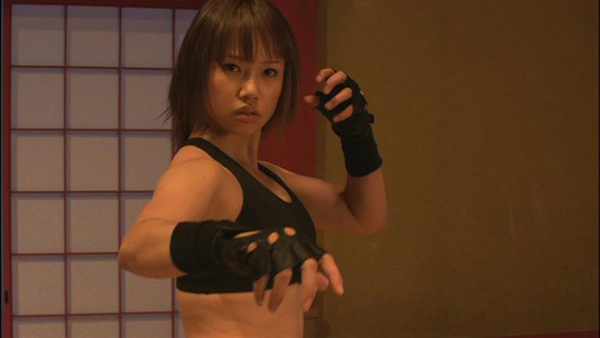
But throughout these 74 minutes Battle Girl does have its moments and at least shows it for being just as ridiculous as Komizu’s earlier efforts behind the lens. While its fairly invariable appearance doesn’t make for any real excitement, it tends to deliver the goods in an unintentionally humorous manner, both in the acting and action departments. The fight sequences, largely carried out by Cutie Suzuki – wearing a non-flattering bin liner of a battle suit – and fellow pro-wrestlers Devil Masami, Eagle Sawai and Shinobu Kandori, are rather surprisingly poorly choreographed: nothing more than slowly performed exchanges of blows, accompanied by cartoon sound effects, which do well to raise a few smiles, albeit at the expense of stripping away any tension that the director is trying to build. With its added explosions, perpetual smoke and unusual smatterings of green blood, Battle Girl isn’t particularly original by any means, but it’s nonetheless a functional time-waster for those who may yet to tire of, well, cute chicks fighting zombies.

Posted in Uncategorized | Leave a comment

Robo-geisha/ロボゲイシャ

robogeisha.jpg

Robo-geisha, 2009

“A new type of girls movie, with tears and laughter!”, announces the trailer, which then promptly goes on to boast 70,000 Youtube viewings for the original teaser.

You see, Noboru Iguchi has been afforded quite a luxury; his movies don’t require obscene amounts of money pumped into their advertising campaigns – The Machine Girl having earned him instant cult status amongst internet crowds, and with it the assumption that everything he touches must subsequently turn to gold. That doesn’t guarantee huge box-office success, however, as back home they tend to receive very limited theatrical runs and live or die by their DVD sales. Western Asian cinema fans have certainly taken quite a shine to the works of both he and his visual effects partner Yoshihiro Nishimura over the past couple of years, and time will only tell just how long they’ll continue to ride the bloody wave of success.

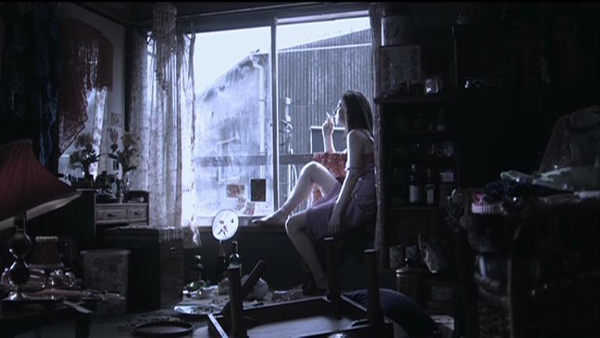
Robo-Geisha tells the story of orphaned sisters Yoshie (Aya Kiguchi) and Kikue (Hitomi Hasebe). Kikue is in the throws of Maiko training, while her younger sister and general dogsbody can only dream of attaining such a rank. Day in and day out Yoshie is bullied by her sister, until one day a client of Kikue’s takes a shine to her. He just so happens to be Hikaru Kageno (Takumi Saitoh), who with his father (Taro Shigaki), runs super military weapons manufacturer ‘Kageno Steel’.

Whisking the pair away to a big ol’ castle, it is soon revealed that Kageno Steel has been hatching a dastardly plot to kidnap young trainee Geishas, weaponizing their bodies and brainwashing them into becoming the ultimate assassins. In the eyes of Hikaru, Yoshie shows the most potential, but she’s soon forced to make a difficult decision; one which will affect her better moral judgement and forever change her life.

Robo-geisha enjoys a distinctly snazzier appearance over that of its elder sister; shot in lush Hi-definition and bursting with colour and exaggerated performances, one can’t help but be reminded of the many manga-like J-Dramas currently doing the rounds. In fact the story itself is so befitting of any number of Japanese social melodramas that in some respects Iguchi’s script could be touted as lazy. However, like The Machine Girl, his film appears to have an intent of lampooning the conventions readily associated within the genre. At the heart of Robo-geisha therein lies a simple tale of a sibling rivalry, replete with an excess of overripe sentiments through which an epic struggle between two girls seeking acceptance unfolds. Much of the feature’s first half deals with domestic violence and unspoken affection in the run up to our protagonist’s transformation; Yoshie is a rather doughy-eyed figure, dressed down so as not to greatly reveal her all-too-evident beauty and portrayed thusly as the caring underdog of the piece, while her elder sister stands as the epitome of superficiality and selfishness.

The contrasting personalities of the two girls makes for an interesting dynamic set against the backdrop of a Geisha house and thanks to a few bouts of role-reversing Iguchi manages to bypass some otherwise predictable routes, even if it does happen to offset the pacing somewhat. The director also finds a moment to take a stab at mass corporate consumption, with his antagonistic suits vying for world domination, while the little people suffer by its hands. Enter an elderly band of disgruntled parental figures – led by a sorely wasted Naoto Takenaka – and the battle between two generations isn’t entirely without relevancy when we begin to see the communication barriers between families and foes take rise.  However, any intended satire this time around lacks the necessary bite, with many of the gags that creep in amidst some lengthy dialogue failing to even raise a smirk, thus inevitability setting an uneven tone for a film of such mixed emotions.

Lifting it out of the doldrums and combating such genre conventions is the overblown CG aesthetics, which, like The Machine Girl, aren’t so much jaw-dropping in their technical prowess as they are absurd and vividly imaginative. As the feature hits its stride midway, Iguchi aggressively culls from obvious sources and allows his work to open up and take on a new lease of life. Yes the Robocop references are here, right down to a homage of the film’s central theme tune, while nods to Kaiju cinema are as hokey as to be expected. The blood-letting is mild, with many practical effects sidelined in favour of animated sprays, overall giving effects guru Yoshihiro Nishimura – who even makes a spirited cameo appearance – few chances to leave a mark. Up-skirt shots, some interesting prosthetic gags – including yet more death-by-food obsessions – and an assortment of weapons strategically placed in various orifices sees Iguchi and Nishimura as the men-children they obviously are: hopelessly immature but uncompromising in their own personal amusement nonetheless.

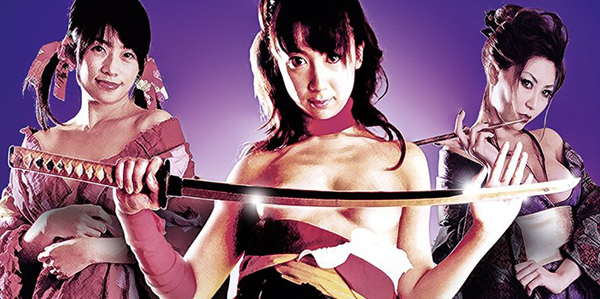
And, as with the gentlemen’s previous features, Robo-Geisha is not only filled with familiar supporting faces, but also places stars from the adult entertainment world at its forefront. Iguchi, who originally carved a career out of producing AV features, casts Gravure idol Aya Kiguchi in the starring role, alongside a devilishly fun Hitomi Hasebe, with what looks to be Hasebe’s swan song, given her recent announcement that she’s to quit the industry. AV Idol Asami Sugiura and Cay Izumi (head of Gothic-Lolita pole-dancing troupe ‘Tokyo Delores’) make up the curious duo of the Tengun sisters, which certainly leaves no shortage of curves and jiggles to get us through some of the lesser moments.

Give him his dues, Noboru Iguchi’s Robo-geisha is an often visual treat, but a compromised one at that, eschewing much of the rampant gore that its predecessor lapped up, all at the behest of a studio this time hoping to appeal to the pre-teen market and above. Don’t let the UK 18 certificate fool you too much; while the skimpy outfits, lactating acid breasts and occasional CG blood-letting might leave cause for concern – even for its own country, more often tolerant of fantasy violence – this is ultimately a light affair, offering little by way of innovation in comparison to the film which made Iguchi’s name.

Posted in Uncategorized | Leave a comment

Party 7

party7

Party 7, 2000

Miki (Masatoshi Nagase) is a small-time crook, who’s decided to abandon his fellow gangsters because he feels he no longer has a suitable future with them; taking with him a few million in yen, he flees to the relatively unknown Hotel New Mexico, located in the countryside. But his sense of security is short-lived when his travel agent, Auntie (Yoneko Matsukane), betrays his location to a string of pursuers. Soon Miki is greeted at the hotel by his former girlfriend Kana (Akemi Kobayashi), to whom he owes a considerable debt of money, while she has been tracked down by her gadget-expert fiancé Todohira (Yoshinori Okada). Things finally erupt with the arrival of Miki’s friend Sonoda (Keisuke Horibe), who has been ordered by his boss to kill Miki and bring home the money he stole. But when Sonoda learns of his own boss’ betrayal he soon begins to question himself whether or not his time is well spent with the clan.

Unbeknownst to the recently re-acquainted, the hotel is a peeping tom’s paradise, governed by the mysterious Captain Banana (Yoshio Harada), who has constructed a secret base of operations adjacent to Miki’s quarters. He’s soon joined by a young man named Okita (Tadanobu Asano): a hopelessly addicted and multiple-convicted peeping tom, who suffers from painful childhood memories and is the perfect foil for Banana’s nefarious schemes in keeping the peeping tradition alive. When Banana informs Okita that he once knew his father, the pair reach a kind of bond – but soon a series of events will dictate a very unusual outcome. Matters aren’t helped a great deal when a toy-collecting, trigger-happy assassin by the name of Wakagashi (Tatsuya Gashuin) is in hot pursuit, ready to unleash his arsenal on the unsuspecting runaways. You can be sure that at the Hotel New Mexico, nothing is quite how it seems.

Katsuhito Ishii – a graduate of television commercials and short animation – has but only a handful of feature films under his belt, but since his 1998 hit debut Shark Skin Man & Peach Hip Girl (subsequently based upon the manga by Minetaro Mochizuki) he’s gone on to prove himself as a director who doesn’t bow easily to convention. The closest he’s ever come to making some sort of sense is with his aforementioned debut and his third feature Cha no Aji (The Taste of Tea), while as a writer his most accessible piece is without a doubt the equally mature teen angst comedy/drama Frog River (directed by Hajime Ishimine). These are films with some semblance of narrative flow, though true to form they exhibit Ishii’s natural flare for surreal visualis and cartoon-ish adventurism. Ishii’s very much a director with dozens of good ideas, pouring as many as he can into each outing by adopting his preferred method of vignette formatting, which often follows a non-linear path. In some cases it can tend to be his undoing, however, as he prioritizes oddball set-ups over sensible storytelling, which ultimately affects the pacing of his movies; it’s something which no matter how much of a fan you may be, seems to have only gotten more out of control over time. His most recent live-action work, Nice no Mori (First Contact/The Funky Forest) – an experiment stemming from Cha no Aji’s leftover budget it seems – being a staggeringly long 150 minutes’ worth of strange, incidental sketches, which simply have to be experienced, rather than discussed. This trait of his, then, tends to divide audiences by a substantial margin, and in all honesty I can see why. He’s a director for those with a lot of patience and an acquired taste in the bizarre.

Released in 2000, Party 7 – his second film – came out to fairly high expectations, with Shark Skin Man & Peach Hip Girl having been one of the highest grossing films Japanese films of 1998. It didn’t do amazing numbers though; Tohokushinsha hurriedly got it out on DVD in the same year, after a limited theatrical release, and from there it’s garnered its own little cult reputation. It’s also one of Ishii’s more difficult pieces to assess. Much like the aforementioned Nice no Mori, Party 7 doesn’t get by so much on the set-up, but rather the interaction of its characters and a winding series of events that share loose connections. There’s a feeling deep down that his stories exhibit some kind of social context and have an emotional pull to them, though his efforts to touch upon humanity in general can prove to be all but fleeting excursions, whilst the desire to present cool and quirky characters is all-too-evident. Certainly in the case of Party 7 he often comes close to delivering bouts of poignancy, but he’s all too quick to hold himself back and not tackle a particular issue or a character’s place to any large degree, which is actually quite refreshing from a certain perspective. To be perfectly honest though, the only character he ever tries to flesh out here is that of Okita, whose unhealthy perversions form the basis for several lengthy transitions, consisting of childhood flashbacks and Captain Banana’s unruly attempts at justifying his actions. Whether or not it’s Ishii’s intent to open discussions regarding the voyeuristic society we seem to be living in today is something that only he seems to know about, but the darker undercurrents lining these moments certainly provide the basis for that thought. As it stands it’s more of an ambiguous plot device which allows the populated cast to eventually come together, whereby their own flaws are each brought to light during a maddening series of exchanges as they struggle to realize just what it is exactly that they’ve managed to walk into.

The story itself does follow a basic pattern: Miki steals money from a Yakuza boss, flees to a fledging hotel in the middle of nowhere, and is then chased down by the boss’s hit-men. Once there events escalate beyond unbelievable coincidence; panic sets in and we end up with an series of unlikely mishaps, fuelled by screeching voices. Ishii’s initial approach is pleasantly sedated, though soon we see the pacing issues start to form. For instance the opening act begins with a conversation between Kanji Tsuda’s pathological desk clerk and Yoshiyuki Morishita’s goofy bellboy about an urban legend concerning a poo that fell out of the sky and impacted a small rural village just out of town. It has no purpose other than to provide a comical payoff during the film’s closing credits – which admittedly is very funny. Following on from this is a fantastically animated opening sequence, which eventually settles down, and it soon becomes clear during the following couple of scenes that this is how Party 7 is going to remain: an inconsistently bumpy ride. Ishii’s sense of humour and pacing lacks all known restraint, with the director keeping scenes going for seemingly indefinite amounts of time, many lasting 5 minutes upward and with little cutting between, thus lending a freestyle attitude as if the film was winging it. It’s certainly admirable that at least Ishii can hold our attention and make us laugh over the most mundane of conversations and sudden character outbursts. Highlights include Captain Banana’s “Top Ten Peeps”, Miki and Morishita’s wig incident and the childish bickering between Kana, Miki, Todohira and Sonoda in such a confined space, but it only goes to showcase just how much of a mash-up things really are as it eventually approaches a manic finale, filled with much confusion and killer polar bears.

Yet most of Party 7 works considerably well on account of its fun and extremely colourful cast, many of whom are regular players in Ishii’s films. Notable exceptions are Yoshio Harada as the ‘eccentric’ Capt. B; Masatoshi Nagase – effortlessly cool once more and looking like he just stepped out of Mystery Train – and the gorgeous, pouting Akemi Kobayashi who actually has little to do other than provide the eye candy in what is her debut appearance. But if we’re going to make distinctions then it’s Keisuke Horibe, previously of SSM&PHG who steals the show as the hopelessly gullible and pitiable yakuza member, duped by his own boss, who has bestowed upon him nothing but the worst clothing and accessory knock-offs in all of Japan; while Tadanobu Asano continues to avoid being pigeonholed by taking on a rather risky role in what would be the film’s most tragic character.

Posted in Uncategorized | Leave a comment

Oh! My Zombie Mermaid/あゝ!一軒家プロレス

zombiemermaid

A! Ikkenya Puroresu, 2004

Director, Naoki Kudo, working from a co-written screenplay by Akira/Sukeban Deka scribe Izo Hashimoto, adds another title to the growing pile of wacky wrestling themed movies, this time with a romantic tale of one man’s fight for happiness.

The late Shinya Hashimoto of New Japan Pro Wrestling plays Kota Shishio, leader of one of Japan’s greatest pro-wrestling organisations. Shishio has decided to hold a house warming party having recently completed his dream project of building his beloved wife Asami (Urara Awata) the perfect home. However, when a man by the name of Ichijoh (Nicholas Pettas) gatecrashes the event, harbouring a deep grudge against Shishio for the death of his brother, all hell breaks loose. A huge fight involving dozens of wrestlers breaks out, leading to the destruction of the new home. Tragically, Asami is caught in the blast and is taken to hospital where upon she’s soon diagnosed with having an unusual skin condition: fish scales begin appearing all over her body, with no known cause as to why.

Standing by his love, Shishio vows to rebuild their home, with the hopes that it will cure Asami of her ailments. But with a lack of funds he finds himself in a difficult situation and even has to approach local gangsters for a loan. Enter Yamaji (Shiro Sano), a documentary film-maker who’s interested in covering Asami and Shishio’s story. He convinces Shishio that he must make a unforgettable return to the ring in a battle for his wife’s honour; a live televised event guaranteed to make headlines and see Shishio back in pocket. But Yamaji isn’t quite what he seems, and soon his corruption will become all too apparent when Shishio places his very life on the line against a line-up of beastly participants.

Another example of a terribly translated Japanese title for the overseas market, Oh! My Zombie Mermaid is amongst the most misleading. Sure there’s a mermaid, only she isn’t a zombie, and there is indeed a zombie of sorts, but only one at that, so go figure. Still, the film is an oddball mixture of genres, one which happily divides its time between semi-serious drama and goofy action, while offering fond homage’s to various modern world cinema classics. Much of the first half sees Shishio attempting to overcome personal barriers and wrestle – as it were – with making the right ethical decisions; there’s very little spread across the first 45 minutes that actually manages to surprise us, with the director squeezing just about every cliché that he can, involving a predictably twisting and turning back-story which explores fierce rivalries and corrupt executives. Our actors play it entirely straight, par the course for contemporary Japanese parody features, as they capitalize upon well-worn themes of revenge and sinister cover-ups in true melodramatic style. If anything it comes across as a ridiculously glorified soap opera, rather befitting of the kind of wacky weekly plots employed by the likes of WWE. It’s all admirably performed though, even if through the script’s sheer nonsense it falls short off triggering our heartier emotions despite the cast’s sincerity.

However, once the evil mastermind of the piece is well established and the challenge is laid down before our hero, the film takes on a new lease of life. The influences readily make themselves apparent as the picture transforms into a cross between The Running Man, with its commentary on media sensationalism and Game of Death, as our hero ascends several floors, each one home to a unique fighter whom he must defeat in order to progress to the next level – the original title of  Ah! House of Pro Wrestling naturally proving to be a lot more apt. And plenty of fun it is too: from a scuffle in a toilet cubicle to a battle held over electrified water and finally onto the obligatory showdown between hero and main boss villain, the director helms a good looking picture; franticly paced, well edited and just all round bonkers.

Oh! My Zombie Mermaid is a fun, slightly deranged feature that proudly wears its influences on its sleeve and showcases a roster of very entertaining talent. If you’re an Asian cinema fan and have found yourself enjoying the likes of The Foul King and the works of Minoru Kawasaki then there’s a good chance you’ll dig this too.

Posted in Uncategorized | Leave a comment

Lalapipo/ララピポ

lalapipo

Lalapipo, 2009

There are only two types of people in this world: People who keep grovelling all their lives, and those who escape that and rise to the heights…

Even with Paco and the Magical Book released in Japanese theatres in the Autumn of 2008, director Tetsuya Nakashima continued to surprise audiences by turning a would-be colourful children’s fantasy romp into a semi-tragic and often poignant tale about the darkness of humanity. Like Memories of Matsuko and – to a lesser extent – Kamikaze Girls before it, he masterfully enriched some of its difficult subject matter with zingy visual aids and a flair for unique characterization. It seems that Nakashima finds it all but impossible to break away from exploring socially relevant themes, which makes it less of a surprise, then, in that he should more recently turn to author Okuda Hideo’s 2005 novel ‘Lalapipo’. This time, however, Nakashima is on writing duties only; forging a screenplay for his former assistant on Kamikaze Girls and Paco – Miyano Masayuki.

Like the book, Lalapipo centres on the lives of six individuals who are each pulled into the sex industry and whose paths converge in the most unusual of ways. We have Kenji (Hiroki Narimiya), a talent scout who dupes young women into becoming porn stars, and whose latest recruit, Tomoko (Yuki Nakamura), happens to fall for his relentless charm and promises of a better life as he gradually takes her through the many prestigious ranks. Every night Kenji manages to take home a different girl, much to the distaste of Hiroshi (Sarutoki Minagawa), a freelance writer living on the floor below, who has all but shut himself away from the rest of society, lamenting that with his credentials he can’t get any women – unlike the charismatic loser above – as he feverishly masturbates with a penis that has a mind of its own. When aspiring seiyu Sayuri (Tomoko Murakami) enters his life the promise of easy sex is too good an opportunity to pass up, but soon he’ll discover that even she has a rather curious job on the side. Elsewhere we meet Koichi (Takashi Yoshimura), a lonely young man working at a Karaoke bar, to whose disgust his employers have started to work hand-in-hand with local pimps. By night he becomes the power-suited ‘Captain Bonita’, a visitor from another world whose mission is to observe Earth life and put evil-doers to rest. Finally there’s Yoshie (Mari Hamada), a middle-aged housewife who has given up on the tedium of taking care of her home and family to pursue a career in AV to satisfy her thirst of wanting to be better appreciated.

An air of familiarity breezes over us as Miyano Masayuki’s picture preludes a series of events set in and around the Japanese sex industry; the manga-like compositions and neon-lit walkways of Roppongi does its bit in mirroring Tetsuya Nakashima’s visual style as it continues to provide a suitably gaudy invitation to a scene filled with many potential pitfalls. In that respect it might appear as if Masayuki – obviously showing tremendous respect toward his peer – comes away with less of an innovative touch, but it’s perhaps just as well in keeping with the tone of Hideo’s novel, itself a cornucopia of wild and weird adventurism set against a stark commentary on a portion of society that’s often freely skirted around. Nakashima and Masayuki seem to understand the source material and the context in which its placed regarding current trends and lifestyles, and in keeping in tune with Lalapipo’s satirical edge they recreate moments with surreal intensity,  using its comic stylings to soften the tale’s inherently dark subject matter with bursts of exaggerated comedy.

One of Masayuki’s greatest strengths, then, is by maintaining a strong pace and striking a neat balance between the film’s tonal shifts. At just 90 minutes in length, Lalapipo has an awful lot of ground to cover, but thanks to a tight script and some strong editing, it interweaves its strands exceptionally well, allowing for a coherent story filled with both joy and tragedy, while exuding a terrific amount of characterization for a selection of lonely souls who might not otherwise earn our best sympathies. While the feature could quite easily go the other way, Masayuki chooses to be a realist in defining these individuals; fantasies are often conjured to deal with their own inadequacies, but the director never wimps out on them by seeking to wring out any great sentimentalism. Rather he presents an intelligent narrative which focuses on different classes scattered across the many rungs of the social ladder: people of various mental conditions who each have their unfortunate pasts, which have led on to them creating self-taught values and philosophies on how their superficial environment chooses to eat up and spit out its inhabitants. The search for love, wealth and finding meaning in one’s life are adequate enough themes for which to explore such often bleak journeys of self-discovery, and the director does well to underlay them with affirming messages, while naturally using sex as a vehicle for man’s most natural desires. Commendably he also affords us a certain amount of ambiguity by leaving us to ponder some unpredictable moments and question whether or not anyone has truly learned any real lessons by the end of it all. It’s not so much a feature of happy endings, but a depicted reality that for all its cartoon-ish veneer is perhaps all too close to home.

Lalapipo will likely divide viewers. Though abundant in surreal visuals and bizarre comedy, it’s not an entirely uplifting affair; its dark topics lining a cynical streak and its resolutions winding up questionable and often unrewarding. It does, however, deserve praise for bravely attempting to dig a little deeper into the workings of the Japanese sex industry, showing some of the harsher realities faced by those drawn into what could be considered an unforgiving lifestyle.

Posted in Uncategorized | Leave a comment

Kakera – A Piece of Our Life/カケラ

kakera

Kakera, 2009

College student Haru Kitagawa (Hikari Mitsushima) has found herself in a bit of a rut: her relationship with boyfriend Ryoto (Tasuku Nagaoka) – who is in turn cheating on his own partner – is in tatters, devoid of any love and existing only for the purpose of sex. Day by day she sullenly walks through life, unable to express her own emotions, until one day, things take a sudden turn.

Whilst enjoying a cappuccino in a local café, Haru is spied by a gangly young woman named Rika (Eriko Nakamura), a complete antithesis in her overall belief of taking chances, who quickly introduces herself and confesses her immediate attraction toward the girl. She tells Haru that she’s a “medical artist”, sculpting prosthetic body part replacements for victims of diseases or accidents. She sees in Haru a sense of longing, and by bringing her own philosophy to the table she hopes to cure her of her feelings of inadequacy. The pair quickly strike up a friendship, which soon sees Haru break away from the drudgery of her predictable life and embrace new experiences.

Momoko Ando is amongst the latest in a generation of film directors who are using the medium to address the issues of identity crisis commonly associated amongst a large portion of young Japanese citizens: those who are afraid to speak out for themselves as they struggle to break away from a strict code of conformity. As a resurgence within the Japanese film industry, then, one can’t help but take stock of such an inevitable series of thematically-linked commentaries which often concern themselves with repressed protagonists who are partaking in journeys of self discovery, set within such an imitable environment. As a tool of communication, it’s clear that directors like Ando hope to one day break through imposed barriers, by bringing to light serious issues which continue to see the country stuck in an endless cycle of uncertainty when it comes to those charged to lead its future.

Themes of seizing opportunities, finding love and being at ease with one’s self provide the basic framework for Ando’s Kakera, adapted from Erika Sakurazawa’s short manga ‘Love Vibes’, and partially based upon some of the director’s own personal experiences. Her debut outing is certainly an admirable one; a film of passion and self-conviction, which carries its message succinctly via a partially sombre tone and quirky cutaways. As a film essentially dealing with an awkward love triangle (or even quadrangle as it later opens up), and one which happens to have at its heart two women falling in love with one another, Ando excels in her refusal to exploit obvious taboo areas by instilling the belief that love is love and gender plays no discernable role. It’s a fresh quality helmed with a Shunji Iwai-like elegance, one which sees such youthful ideology take a positive step toward fighting particular prejudices toward relationships, without resorting to preaching or sentimental cues. Conversely her look at the loveless and male-dominated relationship shared between Haru and Ryota is one of general discomfort in its paving the way for some of the film’s more impending moments, with the hope of escape feeling like an impossibility as it drives home another important issue.

It’s through the intertwining of these components, however, that Kakera falls slightly off balance at times: disquieting moments of abuse, self-loathing and overcoming physical and emotional scars are countered with arty metaphors and light humour, which despite sincere intentions occasionally leaves the picture a little distant the more frustration sets in. But perhaps it’s all part of the point, further noted by its eschewing of the rebellious nature which often inflicts itself upon similar dramas of its type. There’s nothing particularly grandiose here, these women aren’t fighting against any system as such, but rather themselves; that through the hearts of others they can receive affirmation and take the next positive steps in life. Such emotional complexities aren’t easily conveyed, but Momoko Ando chooses to keep things as grounded in reality as possible, even if that means the journey isn’t as strictly entertaining as we might expect.

Kakaera is a confident debut feature from Momoko Ando, one which portrays a familiarly superficial environment through which lost souls find themselves struggling to navigate. As a result it’s a picture of ups and downs and any feel-good sentiments it might give way to are rather downplayed in their poignancy. Some viewers, then, may not find a particularly “entertaining” film per se, but regardless its message is succinct and we’d do well to heed to its advice.

Posted in Uncategorized | Leave a comment

The Japanese Wife Next Door – Part 2/淫乱なる一族 第二章 絶倫の果てに

japanesewife2

Inran Naru Ichizoku: Daini-shō – Zetsurin no Hate ni, 2004

The sequel can’t ever be an easy thing going into. They inevitably come with baggage: anticipation and trepidation in wondering whether or not they can live up to past glory. Some films would have you believe that bigger is better, while others prefer the simpler ethos of building upon the characteristics that made the former so successful in the first place. In rarer instances, there’s the back-to-back workflow, which capitalizes on prior success by ensuring that audiences hungry for more wouldn’t have to wait long for their next fix of epic adventurism.

The Japanese Wife Next Door – Part 2 is astounding in a sense that director Yutaka Ikejima not only made a damn fitting follow-up (shot back-to-back with part 1) but he did both flicks in the space of five days. That kind of output isn’t uncommon for a single Pink movie, but it only makes you wonder just what directors like this – who understand how to maximize a shoestring budget – could do if they had more cash. I imagine the film industry would be in a better place for it.

TJWND 2 is, in fact, a loose sequel, owing itself more to the “What if…?” parallel universe concept than it does in further developing an already established roster of characters and events.

Mirroring the first feature with its shot of businessman Takeshi Ichinose (Naohiro Hirakata) expressing his want of a happily married life, TJWND 2 swiftly sets up the main storyline with our downtrodden fellow finding himself at a bar-meet sandwiched between two lovely lass’s in the form of Sakura (Reiko Yamaguchi) and Ryoko (Akane Yazaki). Struggling to decide between the two, Ryoko takes charge of the situation by shooing away the aggressive Sakura before whisking Takeshi away to a quieter spot, where they soon get a little more acquainted with one another.

Six months later and Takeshi and Ryoko are now married. Takeshi has moved in with her family, the father (Koji Makimura) of whom is a bit of a conspiracy theorist and runs a successful business – of which he never truly discloses – while her mother (Azusa Sakai) happily picks up the chores. Her sister Mina (Lemon Hanazawa), however,  has been left in a mentally unstable condition ever since the death of her biological mother, which leaves Takeshi feeling all the more curious as the days pass. With not a great deal to do, Takeshi soon tires of sitting around and asks to be involved more in his new family’s business, but first, he’s going to have to fill out a life insurance policy. Things are about to get very strange indeed…

Whilst thematically similar to its predecessor (I should note that both films came out within months of each other), TJWND 2 is quite different tonally. This time, rather than the estranged wife awakening the family’s innermost sexual desires, we’re soon made aware that Ryoko’s kin are already raging masochists. The follow-up retains the same levels of oddball activity present in Ikejima’s first tale, but it gradually descends into far blacker territory with its shades of Takashi Miike and Kim Ji-wun as it crosses that fine line of what constitutes taboo – more so within its familial context – and blurs it with often uneasy realism and comic surrealism. Of course, TJWND 2 brings with it a rather outlandish plot, but it’s one that’s focused with an uncompromised determination via its underlying themes of social paranoia and depraved sexuality.

Ikejima’s direction certainly feels fresh from a standpoint that here he takes his comedy of errors and builds it up around a horror-like narrative, which unfolds through a gratifyingly mysterious build up; while there’s an ominous vibe strung throughout – backed up by Hitomi Oba’s low-key but haunting score, and some terrifically voyeuristic compositions – it’s never quite clear as to where the feature will end up on account of the director’s constant teasing. Despite its strangeness, the character transitions and motivations feel credible enough in Ikejima’s hands, and of course, it helps that we’ve most of the same cast returning, each of whom put their chameleon-like skills into creating another unforgettable family of misfits.

A perfect companion piece to its progenitor, The Japanese Wife Next Door – Part 2 is a bold and brave shift in direction from Yutaka Ikejima, who proves he’s a bit of a dab hand at mixing up his genres. Bizarre, tragic and loaded with the kind of sex you expect to see, you won’t be forgetting this one in too much of a hurry.

Posted in Uncategorized | Leave a comment

The Japanese Wife Next Door/淫乱なる一族 第一章 痴人たちの戯れ

japanesewife1

Inran Naru Ichizoku: Dai Isshō – Chijin-tachi no Tawamure, 2004

Takashi Ichinose (Naohiro Hirakata) has recently separated from what he considered to be a lonely four-year relationship, finding that he now yearns for a wife to happily settle down with. Luck seems to take a sudden turn for the better when he attends a singles bar one evening and is greeted by two attractive businesswomen. The first to set her sights on him is Sakura Miyoshi (Reiko Yamaguchi), a vibrant young lass, recently returned from studying in America, who knows how to get what she wants. The other is Ryoko (Akane Yazaki), who happens to be the daughter of the company president that Takashi works for. But he has little time to discuss hobbies and so forth when Sakura takes it upon herself to drag him to the toilet on account of a little fib.

Six months later and Takashi and Sakura are husband and wife, and Takashi feels that it is time for her to move in with him and his family. Grandpa (Koji Makimura) and dad Mitsuo (Kikujiro Honda) seem all too happy to have another lady around the house, as does sister Yayoi (Kaoru Akitsu), who quickly foists the household chores upon the new resident. After a few weeks, Sakura seems to have settled in nicely, but somewhat to the annoyance/envy of her family, as her sex sessions with hubby are becoming increasingly disturbing. Even Takashi begins to feel himself drifting away as he struggles to keep up with her insatiable libido, wondering if he might have made the wrong choice after all. Soon he starts putting in longer hours at work, and in doing so Sakura begins to find other ways to satisfy her needs. She eventually turns to his family members and seduces them one by one, in turn curing them of their ailments and psychological problems. Through these couplings the family finds itself drawing ever closer, except for Takashi, to whom all of this is unbeknownst, who now believes that he’s going backward in life.

Released in 2004, The Japanese Wife Next Door and its other half – both directed by Yutaka Ikejima and featuring many of the same cast members – created an interesting scenario via their presentation of two parallel storylines, which asked what would happen if Takashi did choose the other girl instead? Here though it’s all about Takashi and Sakura, two people seemingly perfect for one another, but who are about to find out that their own personal beliefs are at totally opposite ends of the spectrum.

The Japanese Wife Next Door is a charming little take on sexual politics, which sees one young, headstrong and very sexually active woman take over the lives of a prim and proper family that has for far too long been repressed through tedious moral values. While initially Takashi appears to be the star here, Ikejima swiftly introduces love interest Sakura and places her in the forefront of a feature which clearly has something to say about the close-mindedness of a society when it comes to something so completely natural. “Japan is behind the times” expresses our feisty nymphomaniac on numerous occasions, as she eagerly embraces newfound western ideals, which of course justifies her means of bonking Takashi’s entire family in a bid to liberate their most inner desires! The ultimate embracing of sex allows the household bond to grow stronger, while our leading man gradually becomes more despondent and alienated from his own kin, in turn seeking solace in the woman he originally walked away from. Naturally, Ikejima’s approach toward making his point known – or rather screenwriter Kyoko Godai’s – is completely absurd; the family’s incestuous antics (well, as close to) may not seem particularly inviting from the outset, yet ultimately they still serve to promote exactly what the director is trying to achieve with considerable success.

With said commentary delivered, Ikejima sets about fueling his tale with an eclectic mixture of sexual encounters, and quite frankly they’re a blast. The director – who himself has starred in over five hundred features and has helmed over an unprecedented one hundred within the industry – more than delivers here in sealing his reputation as one of Pink Cinema’s leading greats. It almost becomes a question of what doesn’t he do? From its early build-up to the insanely over-the-top finale, he assaults the viewer’s senses with a wild assortment of fetishist behaviour, each one progressively topping the last in terms of pushing taboo to its limits; it’s all here, from the fairly routine to toy-tastic BDSM and lesbian adventurism. Ikejima generally keeps things quite titillating, with several scenes bordering on the very convincing, thanks to some skilfully placed shots and hushed industry secrets (although thanks to the included commentary track on pink Eiga’s release that is no longer the case!). Above all they’re extremely fun and rarely without humour; the occasional breach of the fourth wall captures it for all its tongue-in-cheekness, while elsewhere there are even unashamed spots of product placement, with the repeated use of the ‘Pearl Nebuto’ dildo and all the effusive praise heaped upon it.

Further tantamount to the film’s enjoyment is the insanely fun cast, made up of screen veterans. As the straight man of the piece, Naohiro Hirakata does well to convey the eventual disbelief of what we’re seeing, while those playing his family members are simply delightful throughout. Koji Makimura playing the Grandfather is especially hilarious in his discovering of new joys, while Kaoru Akitsu’s sexually frustrated nail-biting and Kikujiro Honda’s vexation build up to huge payoffs. But it’s prolific adult video star Reiko Yamaguchi who runs the operation: an incredibly charismatic, strong-willed and shapely lead who we just can’t take our eyes off. It would be a stretch to say that she has a commanding presence as such, but she does have an ability to lull us in with her character’s bubbly personality and uninhibited freedom. As the sole voice of a generation’s younger and fresher ideology, Sakura is one incredibly special gal, discounting of course that she will take your entire family to the cleaners if you’re not careful.

Posted in Uncategorized | Leave a comment

Instant Swamp/インスタント沼

instantswamp

Insutanto numa, 2009

For Haname Jinchoge (Kumiko Aso) life is a bit, well, uneventful. While she pines for an unrequited love, now making a name for himself in Italy, her job as a magazine editor is in jeopardy due to a distinct lack of sales. Day by day she laments the gradual erosion of her existence, seeking comfort only through her nostalgic-fuelled addiction to ‘Milo Sludge’. Even her mother (Keiko Matsuzaka) seems only content with making fantastical claims about water sprites living in her garden, much to her daughter’s chagrin, and it’s not long before Haname decides to get rid of all her worldly possessions and begin a fresh start. Things are about to come to a head when one day Haname receives word that her mother has been hospitalized after plunging into a pond in a bid to catch a Kappa. During a police investigation a long-lost mailbox is uncovered from the accident site, wherein thousands of undelivered – mostly illegible – letters have been stored for decades. One such letter which has managed to survive, however, reveals that the father she thought she once knew was never actually her own; with her mother now in a comatose state, she must takes matters into her own hands and seek the truth.

Soon Haname tracks down the whereabouts of her real father: an eccentric antiques dealer now going by the name of “Light Bulb” (Morio Kazama). Somewhat perturbed by his appearance and hippy mannerisms, Haname decides not to reveal her identity to him, instead merely passing herself off as a distant relative. Each day she returns to Light Bulb’s curious shop and each day they seemingly draw closer through their shared interests. It’s here that Haname befriends an electrician named “Gas” (Ryo Kase), whom she soon has joining her on treasure hunts for other locals, which also spurs her to open up an antique shop all of her own. Life suddenly seems to be looking up for the young dreamer, until an opportunity is presented to her that may see everything come crashing down.

It’s impossible to go through Instant Swamp  Miki Satoshi’s sixth film – without thinking of the director’s second feature Turtles are Surprisingly Fast Swimmers; they’re practically joined at the hip in their telling of female protagonists down on their luck, who wonder what more life can possibly afford them past their presently mundane existence. With linked themes that softly satirize a fiercely superstitious and often complacent society and one’s taking risks in the pursuit of happiness, it may initially appear that this time around we’ve seen everything before. However, Satoshi continues to prove that he still has many more tricks up his sleeve, with a strong knack for characterisation and the ability to convey his messages without having to try all that hard.

As a story teller Miki Satoshi has rarely relied on deeply packed or even logical narratives to make his points clear, and with Instant Swamp opening on Haname’s words that life doesn’t quite work the same way that it does in the movies, he eschews the clichéd components that often lend themselves to more conventional tales of self-discovery, be they romantic, comedic or otherwise. There’s no sentimental button-pressing throughout a plot which harbours ordinarily serious issues, as here we have a director wanting to have fun first and foremost, embracing his unique brand of fairytale humour whilst retaining an overall sense of awareness in his depiction of human emotions and traditionalism. As with most of his films to date, Instant Swamp is all about the journey, working no differently with its mixture of charming and quirky characters to drive events forward. Though the feature clocks in at a slightly lengthy two hours, Satoshi maintains a solid enough pace and through his characters’ bizarre whims and philosophies – especially those central to Haname and Light Bulb – he ensures a constant air of unpredictability amidst some exceptionally refreshing forging of family bonds.

Instant Swamp is imbued with such unbridled energy and a genuine lust for life that it ensures the viewer leaves with a heavy smile. Miki Satoshi has assembled another cracking cast of familiar faces, and central to this is Kumiko Aso (returning after Satoshi’s Adrift in Tokyo) who puts in a spirited performance as our ditzy protagonist: scammed in life, though not wanting to be destroyed by the experience, Haname turns her misfortune into an opportunity which will lead on to one of the most surreally fantastic finales seen in recent years. Another triumph for a director who just cannot seem to do any wrong.

Posted in Uncategorized | Leave a comment