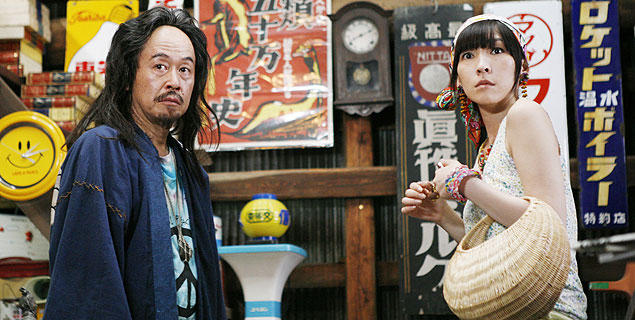
Instant Swamp/インスタント沼

instantswamp

Insutanto numa, 2009

For Haname Jinchoge (Kumiko Aso) life is a bit, well, uneventful. While she pines for an unrequited love, now making a name for himself in Italy, her job as a magazine editor is in jeopardy due to a distinct lack of sales. Day by day she laments the gradual erosion of her existence, seeking comfort only through her nostalgic-fuelled addiction to ‘Milo Sludge’. Even her mother (Keiko Matsuzaka) seems only content with making fantastical claims about water sprites living in her garden, much to her daughter’s chagrin, and it’s not long before Haname decides to get rid of all her worldly possessions and begin a fresh start. Things are about to come to a head when one day Haname receives word that her mother has been hospitalized after plunging into a pond in a bid to catch a Kappa. During a police investigation a long-lost mailbox is uncovered from the accident site, wherein thousands of undelivered – mostly illegible – letters have been stored for decades. One such letter which has managed to survive, however, reveals that the father she thought she once knew was never actually her own; with her mother now in a comatose state, she must takes matters into her own hands and seek the truth.

Soon Haname tracks down the whereabouts of her real father: an eccentric antiques dealer now going by the name of “Light Bulb” (Morio Kazama). Somewhat perturbed by his appearance and hippy mannerisms, Haname decides not to reveal her identity to him, instead merely passing herself off as a distant relative. Each day she returns to Light Bulb’s curious shop and each day they seemingly draw closer through their shared interests. It’s here that Haname befriends an electrician named “Gas” (Ryo Kase), whom she soon has joining her on treasure hunts for other locals, which also spurs her to open up an antique shop all of her own. Life suddenly seems to be looking up for the young dreamer, until an opportunity is presented to her that may see everything come crashing down.

It’s impossible to go through Instant Swamp  Miki Satoshi’s sixth film – without thinking of the director’s second feature Turtles are Surprisingly Fast Swimmers; they’re practically joined at the hip in their telling of female protagonists down on their luck, who wonder what more life can possibly afford them past their presently mundane existence. With linked themes that softly satirize a fiercely superstitious and often complacent society and one’s taking risks in the pursuit of happiness, it may initially appear that this time around we’ve seen everything before. However, Satoshi continues to prove that he still has many more tricks up his sleeve, with a strong knack for characterisation and the ability to convey his messages without having to try all that hard.

As a story teller Miki Satoshi has rarely relied on deeply packed or even logical narratives to make his points clear, and with Instant Swamp opening on Haname’s words that life doesn’t quite work the same way that it does in the movies, he eschews the clichéd components that often lend themselves to more conventional tales of self-discovery, be they romantic, comedic or otherwise. There’s no sentimental button-pressing throughout a plot which harbours ordinarily serious issues, as here we have a director wanting to have fun first and foremost, embracing his unique brand of fairytale humour whilst retaining an overall sense of awareness in his depiction of human emotions and traditionalism. As with most of his films to date, Instant Swamp is all about the journey, working no differently with its mixture of charming and quirky characters to drive events forward. Though the feature clocks in at a slightly lengthy two hours, Satoshi maintains a solid enough pace and through his characters’ bizarre whims and philosophies – especially those central to Haname and Light Bulb – he ensures a constant air of unpredictability amidst some exceptionally refreshing forging of family bonds.

Instant Swamp is imbued with such unbridled energy and a genuine lust for life that it ensures the viewer leaves with a heavy smile. Miki Satoshi has assembled another cracking cast of familiar faces, and central to this is Kumiko Aso (returning after Satoshi’s Adrift in Tokyo) who puts in a spirited performance as our ditzy protagonist: scammed in life, though not wanting to be destroyed by the experience, Haname turns her misfortune into an opportunity which will lead on to one of the most surreally fantastic finales seen in recent years. Another triumph for a director who just cannot seem to do any wrong.
Posted in Uncategorized | Leave a comment

Female Prisoner #701: Scorpion/女囚701号/さそり

femaleprisoner701

Joshū Nana-maru-ichi Gō / Sasori, 1972

Meiko Kaji was twenty five years of age when she took on the role that would define her as a cult icon. She boldly moved to Toei Studios, having been disparaged by Nikkatsu’s new direction in making roman-porno movies, which they had naturally wished for her to partake in. Although she still left behind some notable works, in particular the Stray Cat Rock series, new doors opened up for her, which helped seal her reputation. 1972 saw the first of a four-part series known as Female Prisoner Scorpion, in which she appeared as the downtrodden heroine Nami “Matsu” Matsushima. Helming the first picture, Female Prisoner #701: Scorpion, was Shunya Ito making his debut; the first of three pictures – which were all made within a one year period – that he would direct.

Based on Toru Shinohara’s manga of the same name, the story tells the tale of Nami Matsushima (Meiko Kaji) who has been sent to prison after attempting to kill her ex-boyfriend and corrupt police officer Sugimi (Isao Natsuyagi). Sugimi had used her as yakuza bait after buttering her up with his wiley charm, but little did he know that it would soon be his biggest mistake. While in prison Matsu attempts to escape, but she’s quickly caught and sent into solitary confinement, which in turn screws everything else up for her fellow inmates, who are now facing punishment for her disobedient acts. These women soon make her time spent at the prison very uncomfortable, in addition to trying to fight off the evil police officers who run the joint. But Matsu is left undeterred; her only focus is getting out and wreaking revenge on the man who set her up and not even a dozen police men and the prison’s entire population is going to prevent her from doing so.

Female Prisoner #701: Scorpion is something of an intimate piece of work; its production values lending themselves to a cold and concerning climate, whereby any atrocity witnessed within the walls of Matsu’s enclosure is echoed a thousand times over. The exploitation films of the sixties and seventies that we can attribute Roman Porno and Pinku Violence to were often laced with subtle social commentary, although certainly various directors like Norifumi Suzuki, Chusei Sone and Kazuhiko Yamaguchi, took many liberties with their material. Certainly for the most part the Pinku Violence flicks were far too outlandish and humorous to hammer home any fierce statement, but nonetheless they had merit and oodles of style. In that respect Shunya Ito’s debut feature isn’t much different: yes it portrays an abusive legal system, whereby prison wardens and police officers take advantage of their watch and indeed it depicts low-end tolerance throughout, but equally so it delivers some gruelling visuals, comic inspiration and tense encounters.

Much of Female Prisoner #701: Scorpion’s impact relies on the corruption that it speaks of; the basis of such incarceration is to reprogram and reform criminals so that they might be released back into society in order to start life anew is one fraught with contradiction, as officers mercilessly beat and ridicule every inmate they come into contact with. Ito paints events in very black and white terms, as we see convicts being violated beyond justice regulations, prompting a rise against the system. However, the director also spends as much time on trying to have the majority of fellow inmates attempt to kill Matsu, who has somehow managed to cloud their judgement toward more obvious opposing factors.

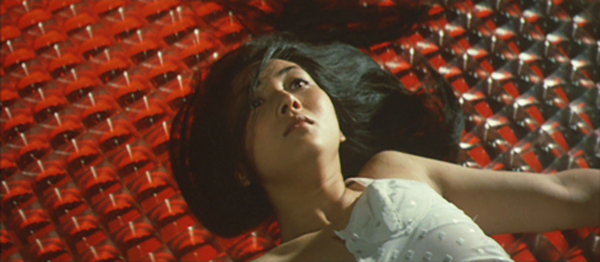
With the prison setting being the primary focus throughout it doesn’t appear as if Shunya Ito has much room to play with, but he manages to surprise us with his bag of tricks, and while not all of them are entirely original some are unquestionably effective. The director stages his film quite masterfully, beginning with an elaborate chase sequence set throughout marshland, which introduces us to Matsu and her friend Yuki. From here onward his camera voyeuristically leans on the daily workings of prison life, where guards look on starry-eyed as naked convicts pass them by one by one. Ito goes on to utilise several interesting framing devices, much in the vein of a manga brought to life, including a fifth wall, or rather a glass floorboard technique reminicent of Kazuhiko Yamaguchi’s Delinquent Girl Boss: Worthless to Confess, put into effect one year prior. He also develops some unique camera movements during fight sequences, which do plenty to compliment the disorienting action; occasionally deviating into surreal territory and harking back to other directors such as Seijun Suzuki and Norifumi Suzuki, with several artistic flourishes that bare far greater impact as metaphorical aids. It’s a gradual progression, with characters early on being equipped with almost demonic qualities: Masaki’s (Yoko Mihara) plan against Matsu back-firing, subsequently turning her into an demonic vision is but a taster of Ito’s hidden talent to unnerve in unusual ways. Likewise, as he approaches the final act, in which the female convicts lead a huge revolt against their suppressors, he paints a literal Hellish landscape, with extreme emphasis placed on swirling red skies, which forewarn a bleak outcome.

Much like Miki Sugimoto in her Zero Woman outing two years later, Meiko Kaji’s tailored role of Matsu draws familiar parallels: both women are driven by revenge in relation to someone they once trusted and similarly they bare the same passive façade, where only their eyes and subtle body language deliver the message that all those who oppose them will end up face down on a cold slab. It’s a bone of contention when trying to unravel the personality behind the characters, because in terms of what we see on film we never truly get an understanding of what these heroines were like before they were traumatized. In Female Prisoner #701: Scorpion, for example, we’re only led to believe that Matsu had lived a happier existence prior to her betrayal. Where we might be taken deeper into a particular character’s history, had it been made anywhere else, we find that as with most exploitation films from Japan it’s more about getting into the action and less about delivering what might be considered measly padding. After all the audiences of the time were never going to see these features for anything else other than boobs and blood-letting. If one is willing to let go of the fact that Matsu is something of an elusive figure, much like Sugimoto’s Rei, and that they can simply support her and cheer her on as she enacts furious revenge against corrupt officials, then there’s a lot of fun to be had. For that matter Kaji isn’t half that bad, despite a thinly veiled script and a huge lack of dialogue, which was incidentally at the behest of the actress, so that she could convey far more with her natural assets – much in the same way that other celebrated icons such as Christina Lindberg and Sugimoto worked best at doing. But it was also an era in which female protagonists seen in such motion pictures only reached equality after being manipulated, or having had the shit kicked out of them. These figures have to earn respect by dishing out the same levels of violence upon their tormentors, which may not make them perfect heroines in the strictest sense, but at least they’re woman who kick major ass and look great doing so.

Female Prisoner #701: Scorpion could be considered tame, next to the standards set by its forbearers and even those since, but this is clearly by design and there is still no denying its effectiveness. It’s suitably brutal and charged with a unique display from Meiko Kaji, while being equally ridiculous thanks to some stereotyped villains and scenarios that our heroine somehow – magically perhaps – gets herself out of.

Posted in Uncategorized | Leave a comment

Executive Koala/コアラ課長

executivekoala

Koara kachô, 2005

Friendly koala to all, Tamura Keichi, is just an average salaryman trying to hold down a job within the stressful pickle industry. At ‘Rabource Pickling Co. Ltd’ he has come up with the proposal of a corporate merging between Rabource and a popular Korean kimchi manufacturer, to which after several meetings his boss, the president of Rabource (who, incidentally is a white rabbit), gives him the go-ahead. Things start to look up for Tamura upon meeting Mr. Kim (Lee Ho) of the Pe Nosan’ company and his pet flying squirrel, Momo. Not only is business great, but so too does Tamura share a loving relationship with Yoko (Elli-Rose), putting behind him his troublesome past. But all of that comes back to haunt him one day when he’s informed by detectives Kitagawa (Eiichi Kikuchi) and Ono (Hironobu Nomura) of Yoko’s brutal slaying. For three years Tamura has been secretly visiting Dr. Nonaka (Arthur Kuroda) in order to cope with the disappearance of his former fiancé Yukari; his memories deeply shrouded in mystery. Does Yoko’s murder really have anything to do with the loss of Yukari? Can Tamura really be so unrelentingly violent? Detective Ono seems to think so, and so does the local convenience store frog. Tamura is about to face his most inner demons as he strives to seek out the truth behind what’s going on in Minoru Kawasaki’s surreal mystery thriller.

Minoru Kawasaki has earned himself a nice little niche reputation as being one of the most absurdist and energetic film makers working in Japan today. His style – born from his childhood days spent watching Kaiju cinema and Sentai television – is unmistakable in its attempts to break barriers by predominantly transplanting oversized animals into everyday human situations. He began directing 8mm shorts at the age of 18 during the latter part of the seventies, and even then films such as 1977’s Huuto which featured a piece of mochi (rice cake) transforming into a giant city-stomping creature, helped to carve his destiny as a film maker with clear intents. Throughout the eighties he worked on various TV and video productions, bringing to life several manga adaptations and children’s stories for instance, while funding personal projects from his own pocket. He continued to produce and direct during the nineties, but it wasn’t until just a few years ago with the festival craze The Calamari Wrestler that he’d start to enjoy worldwide recognition. Since that time he’s been working tirelessly to bring to the screen his own oddball vision, which more often than not sees him parodying various genre flicks as he uniquely channels his love for Kaiju weirdness.

Kawasaki’s follow-on from 2004’s The Calamari Wrestler – made during the same year as wrestling comedy Kabuto-O Beetle – is altogether a different beast from the former, in a sense that it feels a whole lot more evenly paced and assertive. While the evident labour-of-love The Calamari Wrestler was certainly an interesting slice of Kaiju cinema it seemed to be weighed down by a somewhat scattershot script, which ironically lost credibility the more it attempted to unravel the mystery behind the bizarre appearance of its lead character. Executive Koala still follows the whole human-sized animal premise, but this time the director has the better judgement to dispense with explanations, place a giant business-suited koala in the forefront and simply be done with it. As with The Calamari Wrestler, then, our hero is nonetheless treated like any other regular citizen, and that of course is all part of Kawasaki’s charm as a director; that somehow, despite the beastly nature and chinks in the armour, such as visible zips, we can actually buy into such a comic creation and never feel the need to ask the obvious. Of course there is a natural pay-off to Tamura being a koala by the end, but still it’s more than easy to simply go along for the ride.

Kawasaki’s main skill as a director is his natural confidence; he knows exactly what works with relation to this ridiculous cinematic creature and he uses the absolute cheapest method to get the biggest laughs. And indeed Executive Koala is often hilarious, on account of the simplest approach, coupled with having a perfect sense of comic timing. There’s a priceless moment, for example, when upon learning of his girlfriend’s death the camera zooms in on Tamura’s jaw dropping an inch or so; the pitching of the scene is one such exemplary moment which words do little justice, much like a moment earlier on when we see Tamura text-ing his girlfriend on his mobile phone with his overly large and furry fingers. It’s the numerous sight gags that raise the biggest smiles, but with the entire cast playing events totally straight it also opens up a manner of ways for the director to exploit typical genre conventions.

Executive Koala relishes the opportunity to work off of the cliché. Kawasaki manages to wonderfully interweave horror, comedy, romance and suspense to deliver some genuinely workable twists that play up to tried and tested formulas. Indeed, it can be incredibly dark at times, boasting several semi-disturbing sequences dealing with domestic violence. If it wasn’t for the fact that we’re (guiltily) forced to laugh during one particular outburst, which culminates with a koala cackling to himself while a chained woman eats rice from a bowl on all fours, then I’d wager that the feature would be something else entirely. Despite some dark psychological undercurrents, however, the director never fails to remind us that he’s just being silly and nothing is more evident than during the completely insane third act, in which everything comes together in a mash-up of sing-a-longs, martial arts and even more logic-defying sensibilities. But oh, what a rewarding thing to witness.

Make no mistake, Executive Koala is as mad as a hatter, but it’s equally smart to boot. Look beyond its main selling point and you’ll find a feature film all too aware of modern cinema trends; one which deconstructs every possible genre, takes what it needs and still comes away feeling as fresh as a new-born…squid.

Posted in Uncategorized | Leave a comment

Departures/おくりびと

departures

Okuribito, 2008

When Takita Yojiro voiced his disbelief upon winning ‘Best Foreign Film’ at the 2009 Academy Awards, it was easy to understand where he was coming from. Certainly the underdog amongst a chosen few, Departures traverses some serious territory when it comes to deconstructing the time-honoured tradition of Noukanshi, literally meaning “to encoffin”. The Nokanfu, as written by Shinmon Aoki in 1996 (his experiences as a mortician from which Deaprtures is based) is bestowed the task of preparing the dead for the long journey that awaits them in the afterlife. This involves a delicate procedure of cleansing and re-dressing which can be readily associated with many cultures around the world; however there’s something very unique in the artistry of what these select few manage. By its very nature the profession is one largely considered to be taboo in its homeland, but on the face of Yojiro’s compelling tale it’s hopefully one that will earn the respect and understanding it rightfully deserves, as the director instils the belief that we should never judge a book by its cover.

For Daigo Kobayashi (Motoko Masahiro) he’s about to be thrust into a situation he’d never have imagined in a million years. When his new career turn as a professional cellist falls to the wayside after the disbandment of his orchestra, he must quickly think up a new way of securing an income, which includes selling his newly purchased and prized instrument. With few other prospects he doesn’t know what else to do with his future. He decides, along with his doting wife Mika (Hirosue Ryoko), to start up a new life in his old rural hometown. There he spots an advertisement which states nothing more than “Helping with Journeys”. Only it’s not quite the travel agency he expected.

Upon arrival he meets the elderly Ikuei Sasaki (Yamazaki Tsutomu ) and his secretary Yuriko (Kimiko Yo). Sasaki employs him on the spot, showing a complete disinterest in his professional resume. He offers him a tantalising salary before Daigo can even ask what the job is. Not many people stay past asking such a question, and sure enough Daigo is ready to bolt when he learns that he’ll be a Noukanshi’s assistant. The need for money proves too much for him though; Daigo accepts the offer and returns home. He keeps his wife in the dark, knowing that she’ll disapprove of his new profession, but it’s not long before she does learn of his activities and demands that he quit for a “respectable” job. With his marriage on the rocks; old friends beginning to shun him; and the shattered remainders of an awkward upbringing creeping its way back into his life, Daigo must ultimately decide what is right for his own well being.

Although Shinmon Aoki had already expressed his disappointment with regard to certain sacrifices being made to the script (he ended up refusing to have his name or book associated with the credits), he has nonetheless spoken well of the film’s success. Personal ties aside I imagine it’s difficult not to appreciate this cinematic account, which manages to comfortably nestle itself between factual documentation and social drama. While the narrative is there to be exploited, and indeed there is no shortage of timely twists from writer Kundo Koyama, the overall feeling here is that Takita Yojiro, who has enjoyed previous success with his far louder and spiritually fantastical Ashura has struck a delicate balance of good humour and heartfelt poignancy. More importantly, Departures doesn’t morbidly dwell on death, despite its seemingly gloomy facade, but rather in fact celebrates life itself.

The tale is told in a largely reflective manner, cleverly juxtaposing the existence of its central protagonist with that of the philosophical ideals that his newfound job entails: that life is a journey and death signals its destination – but what is it that we’re meant to do with the time between? It’s through entering the homes of complete strangers and diverse families that Daigo slowly comes to terms with the failings of his own upbringing and the prospects of abandoned dreams, as destiny plays no small part in leading him toward his ultimate fate. Koyama’s themes are diverse and naturally humanistic, which allows for a tremendous amount of sympathy to be stirred as our emotions are triggered at regular intervals, with help in no small part thanks to composer Joe Hisaishi, whose beautiful undercurrents resonate through the soul. Skilfully though, director Yojiro earns our empathy amidst all this personal loss by downplaying its tragedy, simply because of its natural appointment; there’s an inherent respect here undoubtedly aimed toward every person watching who has at some point lost a loved one through various circumstances. While Daigo’s awkward situation – which inevitably befalls onto his wife and the local community – lends the narrative a required coherence, it’s the masterfully staged ceremonies themselves that tug on our hearts in bringing together families, highlighting bonds and conveying how one life can be affected for the better through another.

Terrifically acted throughout, with its lead Motoki Masahiro delivering such a passionate and beautifully understated performance for what was to be his pet project, Departures rightfully deserved to be the toast of the 2009 Oscars. An emotionally rewarding feature which reminds us that no matter where we’re from or what we do in life, we’re all the same underneath and should do well to appreciate the little time we have on this planet.

Posted in Uncategorized | Leave a comment

Confessions of a Dog/ポチの告白

confessionsofadog

Pochi no Kokuhaku, 2005

Meet family man Takeda (Shun Sugata): a lowly beat-cop with a physique likened to that of a bear, but who just so happens to have a heart of gold. After inadvertently impressing his superintendent, Takeda is soon offered a promotion within the Criminal Investigation Department. What starts out as a perfect opportunity to rise up through the ranks and provide for his wife (Harumi Inoue) and new-born child, soon turns into a situation of discomfort as Takeda learns of corruption within the force. However, his obligation toward his superior – which even extends to him naming Takeda’s daughter – prevents the detective from questioning his dubious orders. Finding his situation inescapable he goes along with the dirty aspects of his job as the years go by, unaware that he’s become the subject of an investigation being carried out by club-owner Kusama (Jun’ichi Kawamoto) and photographic journalist Kitamura (Kunihiko Ida), who are about to blow the lid on the force’s dark secrets to the national press.

Indie writer-director-producer, Gen Takahashi, has remained one of the Japanese movie scenes’ more low key figures, currently dividing his energy between his homeland and his Hong Kong-based production company, where he makes anything from short films and documentaries to features. Despite having enjoyed cult success over some earlier works, his isn’t a name that’s been shouted to the heavens, at least not until this past year or so, and that’s with regards to a film which he completed back in 2005! Confessions of a Dog, which has enjoyed touring the festival circuit recently, has been touted as being one of the most controversial films to come out of Japan, further hyped with claims that it was banned in its own country for being so vocal against its subject. Somewhat ironic in this instance that the press should take something entirely out of context…

When it comes to exposing taboo issues in Japanese cinema, corruption within its judicial system and the manipulating of news events doesn’t immediately spring to mind. Part of this reason – if director Gen Takahashi is anything to go by – is that directly criticizing the police force just isn’t done. While plenty of other social themes have made their way into various Japanese outlets over the decades in order to incite awareness, assaulting police procedural practices was a rare thing, merely being a subject touched upon in the past through various Yakuza dramas and the like. Things started to open up during the the latter part of the 90s when one brave journalist stepped up to the plate and pleaded for a change in press/public relations. Freelance journalist Yu Terasawa had specialized in exposing police corruption; a job made all the more difficult due to his opposing of the ‘Kisha press club’ system. He argued that the symbiosis between the force and the press was a somewhat lazy one, that the police would dictate how every news story would play out for the cameras and newspapers, with a servile media batting no eyelids and a public seemingly oblivious that they were being taken for a ride. So widespread and perennial was this manipulation within the country that Terasawa would seek foreign help and spread his word online.

With help from Terasawa, then, Gen Takahashi – also drawing from personal experience – fiercely sets out to damn the powers of a law enforcement which he’s been so publicly vocal about despising. At 3 hours and 15 minutes, Confessions of a Dog provides a harsh insight into the shady dealings of the police force and its press relations, and the deep frustrations felt by those trying to expose it. It may seem a daunting task to view at first, but the film is methodically constructed, allowing for its docile pacing to draw us in with ease. Our voice of distrust, Takahashi, doesn’t pull any punches; one of the more ambiguous things about his film is that its events aren’t based on any single case, but rather is built up of a heavy number of files that have been accumulated over an indefinite period of time. Evidently, then, this is the director throwing all of his cards onto the table, in one fell swoop seeing to it that no stone is left unturned. It certainly makes for juicy drama: planted evidence, rape, murder, drugs, extortion, bribery and mob dealings are just a taster of what Confessions of a Dog has to offer, and certainly it’s outrageous enough – however  questionable it may seem – to hold our attention for such a lengthy duration. This is in great part due to three terrific performances, whereby our head officer and pursuing journalists face difficult moral decisions. It all builds up to a well staged climax, designed to burrow into the viewers brain and leave them pondering its words long after the credits have rolled.

However, despite any tension that the film might carry, it remains an emotionally distant affair. An unremittingly cold feature, its weakness resides in a lack of focus toward characterizing its central players, especially that of Shun Sugata’s. Riding the wave of controversy is fine, but Takahashi seems to demonstrate little care for much else over the more pressing matters at hand. Such a thing can be evidenced in his glossing over a five year gap whereby Takeda has become a shadow of his former self; a man who has betrayed his once proud ideals and his loving family in favour of adhering to a skewed form of patriotism. There are moments briefly strewn throughout that examine the awkward nature of entwined family and working lives; an intrinsic part of Japanese culture where traditional values and the peoples’ respect toward their peers could be deemed just as problematic, but the overall lack of important character building makes it difficult for the viewer to fully sympathise (in particular) with the self-destruction of yes-man Takeda.

It seems that such an obtuse act may be Takahashi’s intention, forcefully hammering home his point of an exploited society that’s too afraid to face confrontation; repeatedly referring to the public as “idiots” as he all but pinpoints the blame on a nation so blasé and submissive toward most aspects of everyday life that it has allowed such amoral behaviour to continue. Confessions of a Dog might not help us to understand such a deep psychosis, what with its blunt attitude, but then by the looks of things it doesn’t appear that the director wanted to do much beyond highlighting that this sort of thing exists in the world. Indeed it does, but the question I suppose is who’s really listening?

Posted in Uncategorized | Leave a comment

Anarchy in [JA]Panty/アナーキー・イン・じゃぱんすけ

anarchyja

Anaakii in jyapansuke, 1999

Takahisa Zeze is another name from a notable list to have emerged from the pink scene and onto becoming a much-respected director of commercial features, with hits such as Rush, Moon Child, and the more recent Heaven’s Story. His background in pink cinema, however, is considerably prestigious in it extending a period of over 20 years. Breaking out at the end of the 80s when the genre seemed to be on the verge of extinction, Zeze ultimately proved to be instrumental in keeping the genre alive through his more unorthodox methods. During the 90s he earned the moniker of being one of the “Pink Shitenno” (“Four Heavenly Kings of Pink”), alongside Kazuhiro Sano, Toshiki Sato and Hisayasu Sato. Eschewing the usual rules imparted on these types of features, Zeze’s films were often experimental pieces, focusing more on social concerns and less on using sex as a more obvious means. 

1999’s Anarchy in [JA]Panty – almost literally reproduced here from the original title Anarchy in Japansuke – tells the story of Mizuki (Yumeka Sasaki): a rape victim whose experience would ultimately teach her how to get the things she wants from men. Unable to bear a child, she turns to kidnapping a young boy at a convenience store, naming him Yoshiki, and raising him as if he were her own. Eight years pass and Mizuki finds that fate has once again caught up with her at a convenience store. Here she meets Tatsutoshi (Kazuhiro Sano), a down-on-his-luck store worker, whose lot in life seems to be visiting brothels with his socially awkward friends. Things start to look up when Mizuki and Tatsutoshi seem to settle down as a family, but Mizuki is about to realize that keeping her illegitimately procured son’s past from him is a dangerous gamble.

Chronicling an eighteen year period, beginning in 1981, Anarchy in [JA]Panty is a tragic-comedy of sorts; a journey spanning a time of economic distress and youthful revolt. Zeze’s film is built upon often recurring social themes, with inspired characters that echo the working hardships and deep-set frustration set within an uncertain, yet inevitable climate of change. All of this is fairly admirable, to the extent that the director adopts an unusual approach with regards to the often hindering sex scenes. While these are present in abundance, their inclusion appears to be designed in order to offset the more serious overtones of the picture. Laughs aren’t always going to be guaranteed, however; with Zeze’s figures being a morally indecent crew of desperadoes, many of these acts culminate with some rather crude humour, which additionally nullifies any sense of eroticism that may ordinarily be found.

It’s perhaps unsurprising though that the director chooses to follow this path. Anarchy in [JA]Panty does indeed work best as an examination of human morality and frailty. It’s a grounded piece of work that often resists the temptation to overdo the performances outside of its sexual content, settling on more of a European inspired art-house sensibility, while featuring a loose feminist streak set to a “men are bastards” mentality.  Zeze manages to craft some memorable moments in the process, enabling his feature to overcome some minor shortcomings.

Posted in Uncategorized | Leave a comment

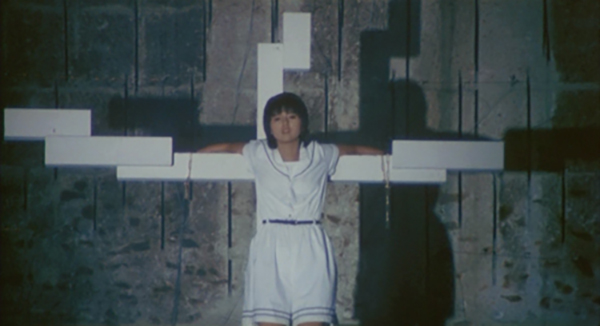
Sailor Suit and Machine Gun/セーラー服と機関銃

sailorsuit

Sērā-fuku to kikanjū, 1981

Based upon the novel of the same name by prolific author Jiro Akagawa, Sailor Suit and Machine Gun tells the story of Hoshi Izumi – Koizumi to her friends – (Hiroko Yakushimaru) – a young schoolgirl whose father has recently passed away. Soon after the death of Hoshi Takashi she receives a letter from him, stating that he’d like his mistress Mayumi (Yuki Kazamatsuri) to stay and befriend her. However, that’s not the end of her troubles. It just so happens that her father was the boss of the Medaka gang and she just so happens to be the 4th Gen successor. But the gang isn’t exactly hot right now as there are only four members: Sakuma (Tsunehiko Watase), Masa (Masaaki Daimon), Aki (Toshiya Sakai) and Hiko (Shinpei Hayashiya). Also they’re in the midst of a turf war with the forty-strong Matsunoki gang, who are also affiliated with the Hamaguchi gang. With Koizumi thrown in the deep end it’s up to Sakuma and company to teach her a little Yakuza etiquette, but there’s no time to waste as battles of honour grow fiercer by the day and the arrival of Mayumi sparks a hunt for missing heroine, with a detective named Kuroki (Akira Emoto) hot on the trail.

Shinji Soumai had only made thirteen films before cancer claimed him in 2001 and his second feature, Sailor Suit and Machine Gun, is one of his most celebrated, not only for its satirical approach toward typical gangster films of the time and changes in society, but also for placing a then-sixteen year old Hiroko Yakushimaru in an unusual central role, which on the basis of a single line uttered earned a massive response across Japan. She was the discovery of producer Haruki Kadokawa, who had placed her in a number of films throughout the eighties including Soumai’s debut feature The Terrible Couple, along with Story of a Detective (also based on an Akagawa novel) W’s Tragedy and Legend of the Eight Samurai. Her popularity soared throughout the decade until she slowed down during the nineties before hitting back hard with a series of popular J dramas and movies. And it’s easy to see what her appeal was back then; what it was that managed to win her so many idol awards. She was the quintessential model for which to reflect upon: sassy, playful, innocent, stubborn – all the things which contrasted against the world around her and it was a role that she effortlessly seemed to sink herself into. Neither could she be deemed classically beautiful in regular cinema terms; her pretty, next-door presense proved to be something of an antithesis and here such qualities ultimately manage to aid the ordinary status of her character, which Soumai eagerly seeks to capture.

Soumai, a former Nikkatsu A.D., approaches his material quite thoughtfully; Sailor Suit and Machine Gun is one of several films of his that notably features extended one-take shots. These almost become a study on nature as the director quite literally lingers over his material, not caring so much about forwarding the plot but capturing a single moment in time – whether it be glorious or not – and savouring it like a fruit pastel. His camera waivers, he employs unsteady hand-held tricks and even pans across tightly closed rooms when ordinarily he shouldn’t have to. While it never badly stalls it has a tendency to jump cut to from one important scene to the next: it briefly bonds characters with lengthy takes and then cruelly disbands them without hesitation, which is most disappointing if by that stage you’ve grown to like them (it should be noted that this review comes from the 112-minute theatrical version, a reported 131-minute Director’s cut has yet to surface). But that could also be Soumai’s genius: taking away Koizumi’s safety net to leave a sudden impact, as if to reiterate that this stuff happens all the time and we just have to deal with it. Certainly if he needed to prove that point then the characters of Koizumi and Sakuma are perfect grounds to do so with. Soumai infuses his film with an equal sharing of teen sentiments and grown up sensibilities; this isn’t solely Koizumi’s adventure in which she must learn to grow in an adult world, but a trial for its predominant male protagonists as well, who find that maybe the life they lead isn’t so desirable after all. There’s a sense that Soumai wishes to convey how important Koizumi is to her group and vice-versa and it does indeed work very well. There’s a charming chemistry shared between Yakushimaru and her co-stars who are each brought to life empathetically and retain their own unique personalities, despite being obvious pastiches of any number of characters from any number of classic Yakuza film offerings, but especially the father figure of Sakuma is well drawn and excellently carried by Yakuza movie veteran Tsunehiko Watase.

That in itself might prove to disappoint some looking for more in the way of heavy action and at times Soumai’s indulgence gets the better of him because we still feel that we should be seeing more than what we get. It should be noted that although the film’s title suggests more in the way of exploitation and action the truth of the matter is that this is more a war of words with precise characterization; Soumai draws out the plight of each gang with lengthy bouts of dialogue and foreboding shots which signpost later events. The title, then, would appear to refer to Koizumi’s ultimate awakening; the moment when she feels truly powerful, as if nothing at that moment could ever stop her from unleashing hell.

The strategic build up to the film’s final moments is well worth the time spent on. Koizumi hits back against those who oppose her in a hail of bullets, letting out an orgasmic sigh which is ripe for dissection, whether it be pointing toward arriving at womanhood, or signalling feminist undertones, any of which make decent sense when taking into consideration the amount of times she’s been scoffed at for being in charge of something belonging to a world that she would ordinarily never be allowed to take part in.  Throughout the feature Soumai utilises some deft humour, not only in mimicking some rather fun Yakuza clichés in order to try and lighten the tone from time to time, but also in taking obvious pot-shots toward a stringent patriarchal system.

Yet the film doesn’t totally rely on being a pastiche, nor does it feels like it’s trying too hard to be one. Sailor Suit and Machine Gun draws a neat line between comedy and drama; it’s a lot of fun and can be disparaging in equal measure, but the concept was quite unlike anything else doing the rounds at the time.

Posted in Uncategorized | Leave a comment

Happily Ever After/自虐の詩

happilyeverafter

Jigyaku no Uta, 2007

Based upon the popular serialised manga Jigyaku no Uta from Yoshiie Gouda, Happily Ever After condenses the tale of the strip’s most famously dysfunctional figures, Isao Hayama and Yukie Morita. Successful mainstream director Yukihiko Tsutsumi tackles a darkly comic tale which ponders over what we consider to be true happiness.

Hiroshi Abe and Miki Nakatani star as Isao and Yukie, a not-so-doting couple on the surface it seems. Yukie grafts at a struggling ramen shop and is adored by her boss (Kenichi Endo), who is just waiting for the perfect time to ask for her hand in marriage. But, for all her hard work, come every pay day she sees her earnings going straight to her ex-yakuza hubby so that he can while away his time at the local pachinko parlour. Moreover, Isao rarely shows his affection toward his wife and suffers from a terrible temper, which usually sees him taking out his rage on the dinner table – of which Yukie‘s neighbouring aunt (Maki Carousel) happily documents. Yet despite his abrasive personality, Yukie continues to love Isao more and more each day. You see, he once saved her from self-destruction several years ago when she fled to a new city after the arrest of her criminal father (Toshiyuki Nishida). 18 years since his arrest, Yukie’s dad is now free and decides to visit his only child, only to find her holed up with this good for nothing bum. The real trial now begins as Yukie and Isao find themselves having to come to terms with some drastic changes in their lives.

Yukihiko Tsutsumi and Hiroshi Abe have enjoyed a considerably productive relationship over the course of the past fifteen years or so, beginning with the hugely successful television drama Trick. Created by Tsutsumi himself in 2000, it ran for three series, spawned four theatrical movies and three feature-length Shinsaku TV specials, which has seen Hiroshi steadily go on to become one of the most commanding actors working in Japan today, effortlessly juggling his time between television and movie appearances. In 2006 he cameoed for Tsutsumi’s videogame adaptation Forbidden Siren and then in 2007 they teamed up twice, firstly with the actor taking top honours in the absurdly cheesy fantasy romp Taitei no Ken, and then following up with the considerably dialled down comedy/drama Happily Ever After.

And it’s a strange one to pin down indeed. Distinctly a film literally of two halves, it explores the characters of Isao and Yukie through a gradually shifting tone, which goes from darkly comic to seriously poignant. While under the surface Tsutsumi offers very little that we haven’t already seen before in Japanese cinema, with a central theme which promptly asks “what is true happiness?”, it’s the unorthodox manner in which events unfold that leaves the piece rather intriguing, even if it might lack a little cohesiveness as a result. None would be truer than the way in which the director explores his central figures, as dividing equal time between the pair seems to be more of an arduous task than one might expect. The film never quite gets to the heart of understanding all of it’s characters, particularly that of Isao who is arguably the most ambiguous character here, as much of the second portion focuses primarily on Yukie’s ropey adolescence and the dubious choices she had made well into womanhood. Perhaps for all intents we needn’t really know every single little thing that makes our protagonists tick; these people are never depicted as being saints who live perfect lives, and that’s naturally a key in understanding the points that the film is trying to illustrate. In fact Tsutsumi does offer some interest in a spot of role reversal which stems from his character’s troublesome pasts, which leads to an inevitably upbeat conclusion, with the director’s message ringing loud over tears of joy.

Above all, however, it’s real key to enjoyment is the impressive cast, who seem to embody their cartoon counterparts tremendously well. Miki Nakatani follows up her award-winning turn in the thematically similar Memories of Matsuko, with yet another noted performance (nominee at the 2008 Japanese Academy Awards) as the ever-so-trying Yukie. The film rests itself firmly on her shoulders, with Tsutsumi asking of us to take a huge leap of faith in discovering Yukie’s past and indeed seeing her reach a kind of spiritual awakening. Nakitani takes it all in her stride, channelling plenty of emotion and once more skilfully ensuring that we laugh and cry with her at all the right beats. Hiroshi Abe, by complete contrast, is left the more complex task of conveying Isao’s emotions through subtle facial mannerisms. The seemingly neer-do-well is a man of very few words, whose idea of settling a problem is by head-butting the nearest person to him. Hiroshi’s timing is impeccable for all his stoicism, managing to make us laugh in anticipation of the next table-flipping incident whenever the wrong word is uttered, or an unavoidable moment occurs. Though he shouldn’t ordinarily be a likeable individual, what with his gambling addiction, general bumming around and a lack of romanticism toward Yukie, he never for an instant leaves the viewer with the impression that he loves her any less than the day he first set eyes on her, and it’s during the moments in which he violently comes to her defence – perhaps the only way he knows how to convey his love – that we can come away feeling quite proud of him.

Tertiary support is also fabulous, with the ever delightful Toshiyuki Nishida – though slightly underused here – helping to flesh out an awkward father/daughter relationship and Kenichi Endo entertaining us through Ishiya’s pitiable acts of unrequited love. These serve to break a little tension between some of the more dramatic overtones and shows Tsutsumi for his love of quirky comedy, which he often infuses in his lighter works.

Happily Ever After won’t claim to be anything truly original; after all it knowingly riffs off standard clichés as it is and culminates with an all-too-familiar message. However, Yukihiko Tsutsumi does well though to hit most of his marks, triumphing over minor imperfections with his energetic style of film making and a cast on hand that is simply too good to pass up.

Posted in Uncategorized | Leave a comment

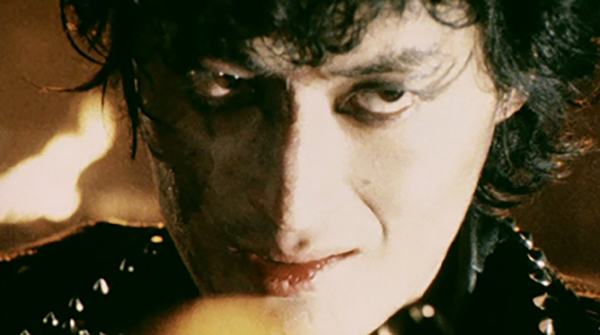
Burst City/爆裂都市

burstcity

Bakuretsu Toshi, 1982

Sogo Ishii was twenty-five years of age when he unleashed the seminal Burst City upon an unsuspecting audience in 1982. Prior to this he had made several short films, with Burst City’s precursor Crazy Thunder Road – a 16mm full-length graduation project – being picked up by Toho distribution. His philosophy was simple: he’d make movies by himself and for himself. Little did he realise at the time just how influential his work would become.

With a film such as Burst City worrying over solid storytelling would be counter-productive, because this isn’t a piece of work that relies on a traditional narrative structure. Sogo Ishii’s breakthrough feature is about sensations; a metaphysical experience whereby music and sounds form the basis of a social divide, encased within the confines of a burgeoning eighties punk scene. Social commentary rears its head, given the fact that what we’re looking at are individual states of mind transcribed as song lyrics; it’s where the feature truly leaves its mark, delivering its ideas and personal feelings via uncommon methods. These are punctuated by enigmatic punk and rock songs, brought forth by an eclectic mixture of bands, hand-picked by Ishii himself, an enthusiast of the scene. Members of The Roosters and The Rockers, Inu, Machida, Stalin, 1984 and even Battle Rockers (the latter of which were created for the sole purpose of the film, but later enjoyed their own success) are amongst those who lend their powerful vocals and explosive physical presence to an overall high-octane apocalyptic scenario.

Fighting society with music; it’s long been a staple component of the rock and punk scene and none are more serious about sticking it to the man than these young and rebellious performers who show us just what real rock is all about, with Ishii even going so far as to have Battle Rockers trample over a Beatles poster as they head onto stage during the film’s opening sequence. In addition to this they all act, convincingly so, with a screen presense which oozes naturalisitc qualities.

Ishii doesn’t just stick to showcasing delirious concert footage. He breaks away from this during several intervals, with a story that’s loosely connected to these powerful anthems; anarchy being most certainly the main focal point with warring gangs and police interventions. He flits back and forth between the Battle Rockers and the Kikkawa Clan’s secret bases, with concerts backed by masses of adoring fans and groupies (six thousand extras were ushered in to create such widespread mayhem), introducing us to a wild assortment of quirky and insane characters, some of whom possess bizarre metal limbs or simply wear salvaged scrap from the heaps ’round back of where they live. He looks at a seedy underside, where exploitation is rife, such as prostitution, drugs and mafia denizens, but he also highlights the dire consequences of each, hammering home valid points and showing us that no matter how glorified some of the actions that we see appear to be, they’re just actions placed on entirely different scales. He excels in showing us reality as well as self-appointed fixations on certain aspects of life.

For a film made with a miniscule budget Burst City impresses with its sheer size and scope and it’s with its visual splendour that we can instantly draw parallels to other works of fiction, from Mad Max to Tetsuo. Unsurprisingly, Ishii maintains an energetic pace throughout and this is a feature that clocks in at almost two hours in length. Pre-dating the Cyberpunk scene by a good five years, Sogo Ishii was already tapping into other possibilities and experimenting with lenses in ways that wouldn’t ordinarily find a place in strict film-making schools. His freestyle approach which proudly displays abnormalities and signifies amateurish qualities actually end up aiding the overall nature of the film; a melding of fictitious and factual moments that are conveyed in gritty realism; a sort of pseudo-documentary if you will.

Burst City takes place mostly in a gigantic constructed set that was built just outside of Kawaguchi City in the Saitama prefecture. As such the film is an entirely industrial picture that’s cold and grey, coming to life at night where it’s infused with frequent rocking and Ishii’s stunning use of speed-editing that today would be instantly recognised in the works of Miike, Tsukamoto and a host of Western directors. In addition he plays with several mediums and manipulates images with daring use of colour; transforming tones from scene to scene by diffusing the palette and bringing us stark and gritty juxtapositions as black and white and colour photography seamlessly merge into each other. It creates a manic assault on the senses as Ishii displays his psychedelic punk roots, while art director Shigeru Izumiya creates a perfectly apt toilet of the world.

Posted in Uncategorized | Leave a comment

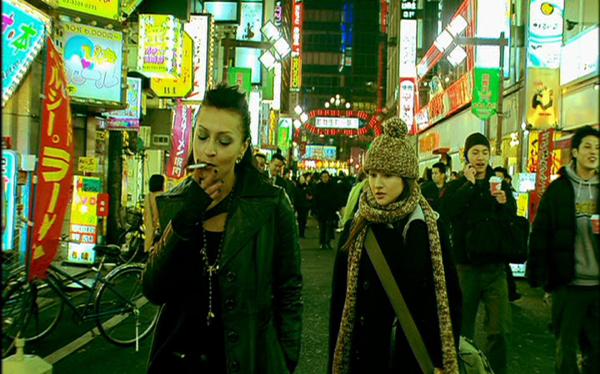
Black Kiss/ブラックキス

blackkiss

a.k.a. Synchronicity, 2004

Asuka (Reika Hashimoto) has recently arrived in Tokyo to pursue her modelling career, and while she’s become familiar with some of the local models, she finds herself sharing so very little in common with them. Feeling somewhat alienated and with little cash to her name she’s uncertain as to how far she’ll go in this city. As good fortune would have it, though, she’s pointed in the direction of former model Kasumi (Kaori Kawamura), who in contrast to Asuka is a hardened, laid back and street-wise gal who only looks out for number one. Kasumi decides to let Asuka stay at her apartment for one night, but she quickly develops a fondness for the young woman, which soon sees Asuka’s luck turn around.

One evening, however, Asuka witnesses a murder from an apartment across the street. When the police arrive, led by Shirasaki (Shunsuke Matsuoka), they discover a male victim spread out on a bed with voodoo markings carved into his remaining flesh. This unusual, yet precision-based killing, which has left no traces of evidence in a room locked from the inside, leads investigators to believe that perhaps there are mystical forces at play. But the murders soon escalate, each one more bizarre and horrific than the last, with the only clue to each being a calling card which simply displays a kiss marked by black lipstick. As the bodies begin to pile up it soon becomes clear that each victim has in one way or another been linked to Kasumi – and it wouldn‘t be the first time given her past boyfriends’ untimely deaths –  enough to have earned her the nickname “The Devil“. Asuka may just be in more trouble than she knows; she even has her own stalker! (Masanobu Ando).

Within the first ten minutes of Black Kiss a few things are apparent – Makoto Tezuka (son of legendary manga-ka and animator Osamu Tezuka) adores Hitchcock and Giallo, with his rain-soaked sleazy streets paving the way for an assortment of healthy references. There’s little subtlety at all in issuing sly nods toward some of Hitchcock’s quintessential thrillers: The Bats Motel and its staged shower sequence, or the Vertigo Nightclub and voyeuristic Rear Window set-up. This certainly raises a smile and gives us the impression of a film-lover paying much respect to a true master, all the while adopting a thriving colour scheme to shape his own film’s grisly undertones and highlight the workings of the Red-Light District. With the help of cinematographer Shirao Kushiro, Tezuka pays additional homage to auteurs such as Dario Argento and Norifumi Suzuki; directors whose own style it could be said is inimitable. However, Tezuka does a remarkably good job of re-creating such well established tones with stark green washes, deep reds (fnarr) and piss-yellow hues, the film’s lighting and compositions being the key toward Black Kiss’s overall success as a feast for the eyes.

Shot in High Definition, it wouldn’t ordinarily be an easy thing to achieve; the lack of real grit in the source materials for instance tends to leave an almost too pristine and clinical looking palette that doesn’t quite bare the same sting as the Giallo genre did, and yet it doesn’t really lose its integral film-like qualities either. At times Black Kiss feels considerably raw – almost pseudo-documentary in parts – and its editing a tad non-linear, with many a sudden inter-cut. It leaves few precious moments for its audience to feel safe, with an intriguing atmosphere that shrouds a convoluted narrative.

Although Black Kiss’s visual influences are indeed broad, it’s the aforementioned narrative which sees Tezuka lend more of a personal touch. The script evolved from a short story of his written ten years prior about an occult detective (Clive Barker anyone?) being drawn into a mysterious case. The film was originally labelled as Synchronicity, a title spoken by the director to literally translate as “Meaningful Coincidences”. It’s perhaps more apt, then, that the working title holds more value than the hipper sounding one we ended up with. While Tezuka has spoken of developing the mystery of his psychological film and how each character correlates to one another, he doesn’t readily talk about the nihilistic social undertones that permeate throughout.

Black Kiss appears to be quite the cynical production. Sure it works as a heightened thriller that keeps us on our toes every step of the way, but it harbours an unmistakable mean-streak as it tends to often revisit Japan’s superficiality with relation to choice sectors of the entertainment industry. Right from the film’s opening sequence young girls are being readily plucked off the streets to be made into “stars”, while aspiring models are being exploited by smooth operators in fancy restaurants who are simply after a good time. Soon afterward, as we’re taken behind the scenes of a fashion shoot, we bare witness to some cruel jibes aimed in the direction of Reika Hashimoto’s naïve out-of-towner, reminding us of an upper-class, cut-throat industry, which – here it suggests – goes hand in hand with that of the seedier underbelly of society. Tezuka thus sets up a side-plot focusing on the innocent Asuka struggling to get by in the big, harsh city, who in many ways isn’t a great deal unlike the equally shunned Kasumi with her jaded past. This then plays on some of the ideas explored in an earlier feature of his: Hakuchi [The Innocent] (also featuring the director’s fave, Hashimoto). His themes of isolation, dejection and loneliness tie in well with the larger scheme of things and create lead characters who have an appreciated amount of depth; this can indeed be considered a strong tale of friendship as much as anything else given the way it plays on chance encounters altering the course of someone’s life. Moreover, each time I sit down to this the more I seem to pick out even the intricate murders as being an unspoken gesture in themselves. If looking at how Masanobu Ando’s stalker/photographer is handled, for instance, it’s almost as if the overtly imaginative killings are speaking out against a pretentious art world: mutilated bodies are tied with neat ribbons and nicely packaged; dolled up to look like shop mannequins, or intricately stripped apart as they lay on silk sheets, revealing their internal organs like they were the work of a proud sculpture. Certainly not dismissive by any means, it only goes to add an extra layer to Tezuka’s evidently ambiguous script.

At 133 minutes in length, however, Black Kiss is unnecessarily lengthy. The story has all the makings of a solid TV drama, what with the director cramming in so many ideas. To be fair he handles things quite well, even if it might not be an entirely smooth ride. Not only is he dealing with all of the aforementioned but he’s additionally trying to create a tense mystery thriller by throwing in an investigative angle featuring local detectives. Forthwith he sets up a slew of red-herrings and quite literally every character is a suspect; some of these work wonders in frustrating the viewer, while others can be irritating if simply because the director is pointing fingers for the sake of it, but like a good episode of Morse it keeps us guessing right until the very end, by which point the machinations of the plot start to get a little out of hand.

Spoilers for the duration of this paragraph.

While the film’s conclusion ultimately makes sense it does go against a more lateral way of thinking. Considering the extensive build-up and a somewhat grounded sense of reality that it seeks to present, it becomes a stretch to buy into the unfathomable and mystical reveal of the killer, which ties in to earlier scenes detailing ritualistic voodoo: an abnormally agile professional killer who dresses as a gimp! Sure enough Tezuka cheats us real good and you can even sense that he’s feeling pretty happy with himself. Yet I’m not particularly annoyed with him, he does give us a good run for our money and I’m all too happy to suspend some disbelief given that overall he’s managed to create an intriguing tale that does indeed present a little substance along with its style.

Posted in Uncategorized | Leave a comment